Binance has told users across its entire platform that it will stop processing transactions with sixteen named crypto services, the exchange HTX among them, and it is applying the restriction to every account it holds rather than only to customers in the countries that ordered the underlying sanctions.
In a notice dated 14 August 2026, the company said it would “cease processing transactions” with the listed services, whether funds move to them directly or are routed through another provider, pointing to recent regulatory developments. The cut-offs are staggered across three dates. Once each deadline passes, an attempt to move value to or from a listed service may trigger a compliance review and restrictions on the user’s wallet, and Binance warns it may be treated as a breach of its terms of use.
One list, two governments, three dates
The roster is not a single sanctions action. It stitches together separate measures from two governments, which is why the labels being attached to it in some coverage do not quite fit.
The two earliest names, Shelbit and Aban Tether Exchange, were cut off on 7 August. Both were designated by the US Treasury’s Office of Foreign Assets Control over links to Iran, in an action aimed at financing routes tied to the country, and neither has any connection to the European measures that account for the rest of the list.
A second group tied to the A7 cross-border settlement network, including its African arm, followed on 13 August. A7 and its rouble-backed A7A5 stablecoin have been targeted by authorities in the United States, the United Kingdom and the European Union as a channel for moving value out of Russia after earlier exchanges were shut down.
The largest batch, eleven services including HTX and EXMO, comes off on 23 August. That date is not incidental. It is the day the European Union’s twenty-first sanctions package, adopted on 23 July 2026, brings its crypto transaction ban into force.
The EU reaches past its own borders
What makes the European measure worth the attention of compliance teams is less the length of the list than the mechanism behind it. Every platform named in the package sits outside the EU, in Georgia, the United Arab Emirates, Panama, the Marshall Islands, Kyrgyzstan and Belarus. The package carries a power for the bloc to bar transactions with crypto providers based in third countries when those countries host services used to work around Russian sanctions. It is an attempt to follow the money past the jurisdictions the EU can regulate directly.
HTX, which the EU lists under the entity name Huobi Global SA and which is associated with Justin Sun, falls into that group under a transaction ban rather than a full asset freeze. The exchange had earlier contested related United Kingdom sanctions, arguing that the designated entity is separate from the live HTX business and that it had declined to list the A7A5 stablecoin.
Why the block covers every user, not just Europe
Nothing obliges Binance to enforce an EU or US list against a customer in, say, Latin America or Southeast Asia. Choosing to do so anyway is the part of this that matters most for the wider market. When a global exchange applies the strictest available sanctions list to its whole user base, it closes the easy option of routing a restricted flow through a more permissive country, and it quietly moves a share of enforcement onto a private operator rather than leaving it with national regulators.
For anyone still holding funds on, or transacting with, the named services, the practical message is blunt: expect those routes into and out of Binance to close on the stated dates, and do not count on a grace period once they do.
Justin Sun disputes the reach
In a post on X on 15 August 2026, Justin Sun said he had “communicated with Binance” and that the change “only involves Binance UK and EU users,” adding that “Huobi itself does not conduct business in the UK or EU.” He said settlement negotiations with UK and EU regulators were already underway and that any affected users could contact Huobi customer service in the meantime.
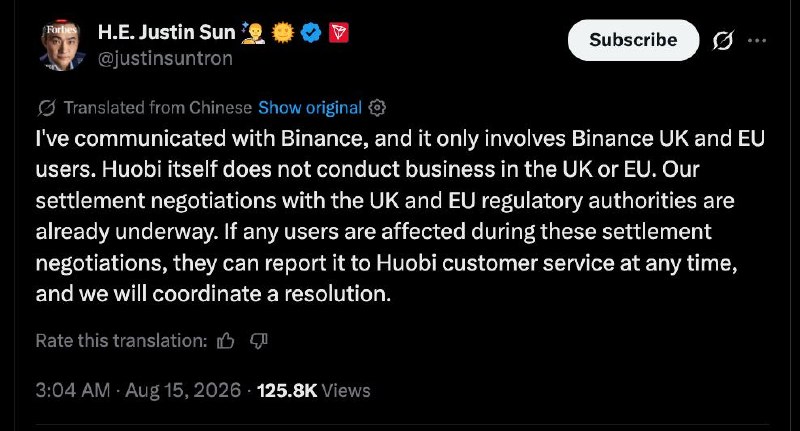
His account is narrower than the notice it responds to. Binance’s own wording describes the restriction applying across its platform rather than to a single region, and the EU measure bars transactions with the listed platforms regardless of a Binance user’s location. Whether the practical effect is felt only by UK and EU customers, as Sun suggests, or more widely, as Binance’s global framing implies, is one question the notice itself does not settle.
Part of a tightening pattern
The move fits a trend in which sanctions authorities and the exchanges downstream of them are going after the specific rails that carry sanctioned value rather than chasing individual wallets. The A7A5 network at the centre of the European measures grew out of the collapse of Garantex, a Russia-linked exchange closed in 2025, whose balances migrated to a successor service. Cutting off the platforms that move that value is now being done not only by regulators drawing up lists but by the venues that would otherwise settle the trades.
Binance has not explained, beyond its reference to regulatory developments, how it reached the exact set of sixteen or how it will handle a user caught mid-transfer when a deadline lands. What is clear from the notice is the direction of travel: the list is set, the dates are fixed, and the block will apply wherever the user happens to be.
Taken together, the move reads as a further step down the regulated path, with Binance doing the kind of compliance due diligence now expected of a global exchange.