
ASEAN Tech Summit Manila 2026 28 July - Changpeng Zhao (CZ), co-founder and former CEO of Binance, joined Lito Villanueva, Chairman of FinTech Alliance PH, for a fireside session examining the convergence of artificial intelligence, digital asset regulation, and cross-border financial infrastructure.
The discussion centred on the structural friction facing global fintech operators: fragmentation in regional oversight, the realities of AI-driven trade execution, and the misconception surrounding crypto-driven financial crime.
Key Takeaways
- License Portability: CZ proposed a “regulatory passporting” model (“license portability”), allowing financial institutions holding licenses from tier-1 regulators (e.g., ADGM or MAS) to operate across regional jurisdictions through streamlined recognition rather than redundant licensing processes.
- Institutional Precedents: Regional passporting is not a theoretical concept; it directly adapts established mutual-recognition mechanisms—such as the ASEAN Capital Markets Forum’s (ACMF) CIS Framework for fund passporting and the European Union’s MiCA regime for crypto-asset service providers (CASPs).
- Shared AI Liability: As AI agents execute automated trades and interact with protocols, liability must be split: users must practice strict capital sizing and risk management, while developers are obligated to build verifiable guardrails and eliminate technical hallucinations.
- The Illicit Data Disconnect: On-chain analytics indicate that illicit transactions account for roughly 0.0014% of total crypto volume—compared to an estimated 2% to 5% in traditional fiat banking—making blockchain traceability one of law enforcement’s most effective tools.
- Political vs. Technical Infrastructure: Regional payment rails (such as the ASEAN Digital Economy Framework Agreement) face political alignment hurdles—including FX controls, tax parity, and national protectionism—rather than underlying software limitations.
The Policy Proposal: Regulatory Passporting & License Portability
The central policy recommendation to emerge from the summit was the adoption of regulatory passporting across emerging markets, specifically within the ASEAN trade bloc.
CZ noted that Binance holds between 22 and 25 global operating licenses, exceeding the cross-border licensing footprints of most global banking institutions. However, navigating duplicate licensing applications in every new jurisdiction inflates compliance overhead without providing additional consumer protection.
Villanueva endorsed the approach under the moniker “License Portability”, emphasising that establishing mutual recognition frameworks across ASEAN regulators would lower barriers to foreign direct investment (FDI), expand consumer access, and enable vetted fintech operators to scale quickly while maintaining strict compliance telemetry.
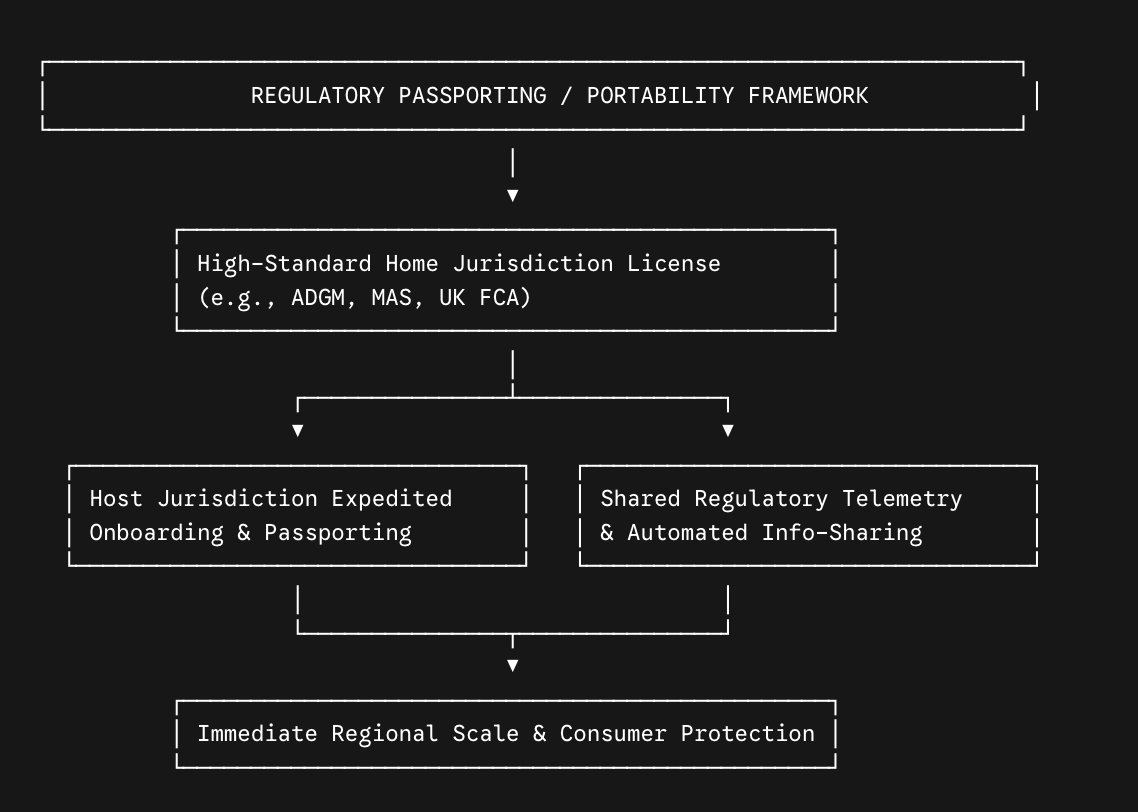
“When you passport another jurisdiction’s licenses, you automatically import all of the businesses that reputable regulators have already vetted and approved… Competition is ultimately the best protection for consumers.”
— Changpeng Zhao
Institutional Precedents & Global Benchmarks
The proposal for digital asset license portability does not require creating a new regulatory apparatus from scratch; it anchors directly into established regional and international legal models:
1. ASEAN Capital Markets Forum (ACMF) Precedents
Southeast Asia already possesses a functional blueprint for mutual recognition in traditional finance:
- Collective Investment Schemes (CIS) Framework: Operationalised by the ACMF across Malaysia, Singapore, Thailand, and expanded to the Philippines, this scheme permits retail funds authorised in their home country to be distributed in host jurisdictions via a streamlined authorisation process.
- ACMF Professional Mobility Pass: Allows qualified investment advisers licensed in one participating ASEAN state to access fast-tracked registration to offer advisory services across borders.
2. The European Union Benchmark (MiCA)
In contrast to ASEAN’s currently fragmented, market-by-market approval model, the European Union’s Markets in Crypto-Assets (MiCA) regulation offers a clear proof of concept. Under MiCA, an authorised Crypto-Asset Service Provider (CASP) in one EU member state receives single-license passporting rights across all 27 member states through a standardised home-regulator notification process. Adopting a similar framework across ASEAN would immediately lower structural compliance costs and attract institutional capital to the region.
AI Telemetry & Automated Trade Liability
Addressing the rise of autonomous AI agents interacting with smart contracts and executing trades, the speakers tackled the emerging legal question of liability when an AI agent suffers a loss or falls victim to a deepfake exploit.
CZ on liability in autonomous execution is inherently shared:
- Developer Responsibility: Developers of AI infrastructure and financial agents must ensure their software functions strictly as advertised, eliminating system hallucinations and embedding safety controls.
- User Risk Sizing: Consumers must manage exposure by capping the capital entrusted to automated agents. Given the early stage of the technology, initial agent delegation should be limited to manageable transaction limits (e.g., small automated travel bookings or minor trades) rather than full portfolio control.
Anti-Scam Controls & On-Chain AI Filtering
To combat deepfakes and social-engineering scams targeting retail users, platforms are deploying proactive AI monitoring tools directly at the wallet level. Wallet providers (such as Trust Wallet) and exchange infrastructure now utilise real-time transaction analysis to flag and block outbound transfers to unverified or suspicious contracts, interrupting scam attempts prior to settlement.
Comparative Analysis: Illicit Value Transfer
A major point of discussion was the disconnect between public perception and actual data regarding illicit financial flows. CZ cited third-party blockchain analytics data showing that illicit transactions represent a fraction of a percent of total digital asset activity, standing in contrast to traditional fiat metrics:
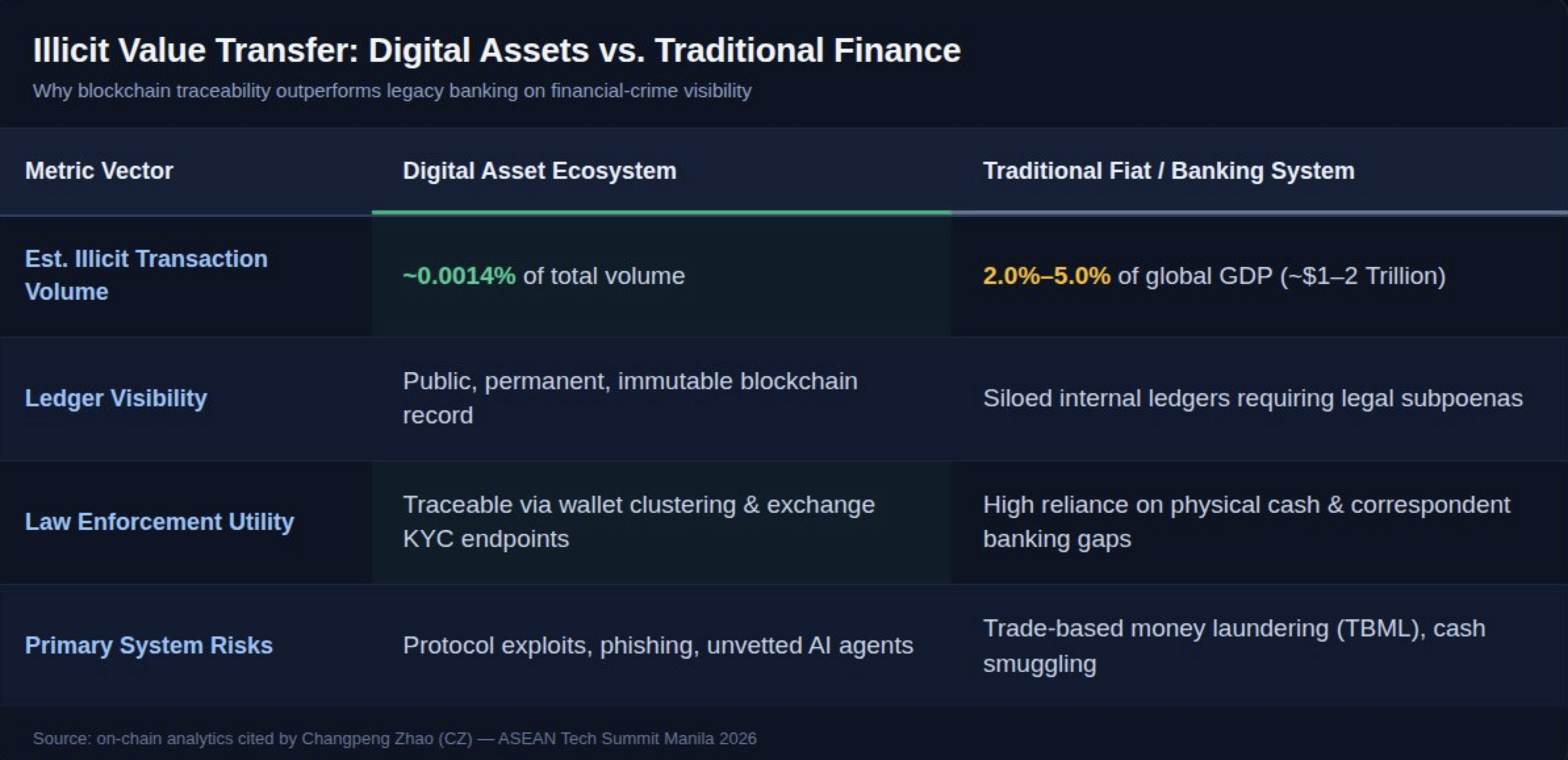 The speakers stressed that because public blockchains provide a permanent audit trail, law enforcement agencies globally are increasingly leveraging centralised exchange Financial Intelligence Units (FIUs) to track and seize illicit funds.
Sovereign Money vs. Private Stablecoins
Addressing the regional push toward Central Bank Digital Currencies (CBDCs) and national stablecoins, the discussion highlighted that end-users prioritise utility over issuer identity:
- User Priorities: Retail and institutional users choose payment rails based primarily on speed, transaction fees, and ease of integration—not whether the token is issued by a sovereign entity or a private firm.
- The Adoption Bottleneck: While national stablecoins carry inherent sovereign trust, they are frequently constrained by strict capital controls and usage restrictions. Conversely, private issuers like Tether (USDT) have built market share by focusing on frictionless UX, deep liquidity, and cross-border accessibility.
The RegTech Outlook
The Manila summit underscored that the primary hurdles facing the next phase of digital finance are policy-driven rather than technological. While AI risk mitigation and on-chain fraud detection can be handled via software iterations, building a unified digital economy across emerging markets requires regulators to move past outdated legal frameworks, build on existing ACMF precedents, and adopt scalable mutual-recognition models.