
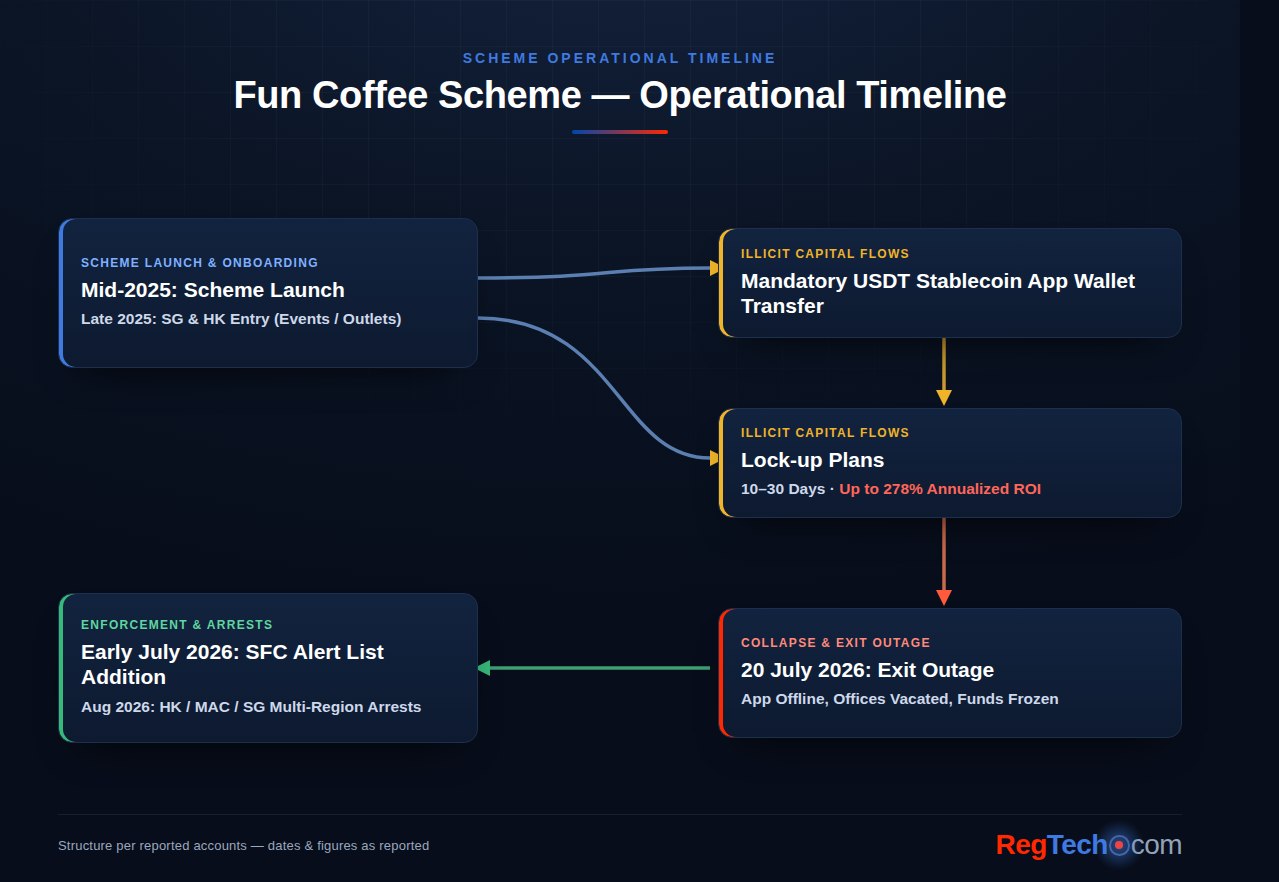
A coordinated regional law enforcement response across Hong Kong, Macau, and Singapore has unmasked the operational collapse of “Fun Coffee” (also operating as Fun Coffee GCM), an alleged multi-level marketing (MLM) cryptocurrency investment scheme. Purporting to operate a high-tech lifestyle coffee and agritech brand out of Phu Quoc, Vietnam, claiming over US$1 billion in assets and a robotic café retail presence in Singapore, the platform abruptly halted all user withdrawals on 20 July 2026.
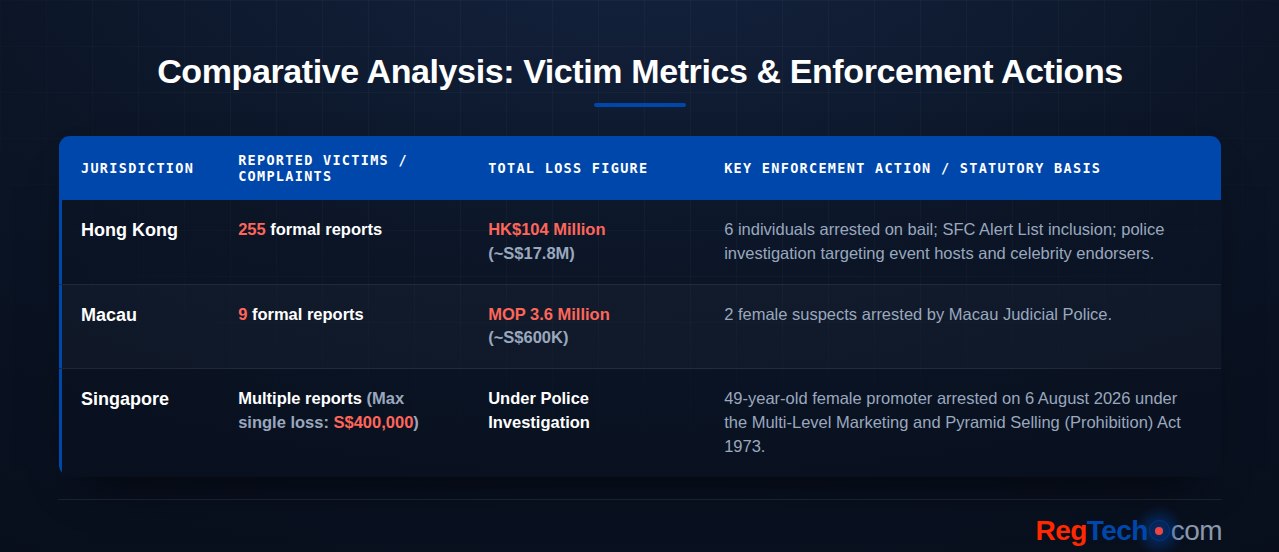
In Hong Kong alone, reported losses have surpassed HK$104 million across 255 formal police reports, while Macau's Judiciary Police recorded a separate nine cases involving about MOP 3.6 million. Individual losses reached up to HK$9.6 million in Hong Kong and S$400,000 for a single retail investor in Singapore.
Law enforcement agencies in three jurisdictions have initiated criminal proceedings:
- Hong Kong: Police arrested six individuals on suspicion of conspiracy to defraud, while contacting entertainers and event hosts who participated in promotional gatherings.
- Macau: Judicial Police detained two suspects linked to nine local reports involving MOP 3.6 million in losses.
- Singapore: On 6 August 2026, the Singapore Police Force (SPF) arrested a 49-year-old female promoter under Section 3 of the Multi-Level Marketing and Pyramid Selling (Prohibition) Act 1973 on suspicion of recruiting participants into the scheme.
Essential Findings
- Regulatory Warning Signs: The Hong Kong SFC added Fun Coffee to its Alert List of Suspicious Investment Products on 13 July 2026, one week before the platform shut down.
- Physical Grounding Strategy: The syndicate projected legitimacy by establishing physical retail storefronts, sponsoring community events, and hosting banquets.
- Criminal Liability for Promoters: Individuals who market pyramid schemes face prosecution under Singapore's Multi-Level Marketing and Pyramid Selling (Prohibition) Act 1973, which carries penalties of up to five years' imprisonment and fines up to S$200,000.
- Crypto Exfiltration Channel: Forcing all investor deposits into Tether (USDT) allegedly enabled the platform to bypass traditional banking AML controls and move capital cross-border.
Deconstructing the Scam Methodologies
An analysis of police briefings, regulatory alerts, and victim accounts reveals a multi-layered hybrid scam model combining classic Ponzi economics with modern Web3 asset exfiltration:
1. The High-Yield Lock-Up (Ponzi Mechanism)
The scheme divided investments into short-term "packages" promising mathematically impossible returns. Hong Kong police pointed to one investment tier in which participants locked up 10,800 USDT (about HK$84,000) for a 10-day cycle in exchange for 680 USDT (about HK$5,300), a payout equivalent to an annualised rate of roughly 230%. Across its various plans, advertised annualised returns ranged from 197% to 278%.
2. Liquidity Baiting & Early Withdrawal Traps
To overcome initial investor scepticism, early participants were permitted to withdraw small profit dividends during late 2025 and early 2026. Authorities allege this engineered liquidity was designed to build false trust, prompting victims to reinvest their life savings, business capital, and recruit personal networks.
3. Pyramid Commissioning & Gamified Engagement
The "Fun Coffee" mobile application incentivised rapid user acquisition through tiered referral rewards, deposit bonuses, and daily check-in incentives. In Singapore, organisers offered cash bounties (e.g., paying S$100 to promoters who brought 10 attendees to company fun runs, plus S$50 per guest), creating an offline community recruitment funnel.
4. The "Agritech/BioTech" Narrative Overlay
According to police, Fun Coffee allegedly manufactured a complex corporate story to explain the source of its abnormal yields. Investors were reportedly told their capital directly funded high-tech coffee equipment, coffee gene optimisation research, agricultural machinery, and wellness innovations across Southeast Asia.
5. Sudden App Severance & Office Vacancies
On 20 July 2026, the application's infrastructure was unilaterally shut down. Customer support channels ceased responding, and physical offices and retail stores in Hong Kong and Singapore were abandoned almost overnight.
Sources: Hong Kong Police Force, Singapore Police Force, SFC, Macau Judicial Police, The Straits Times
Payment Routing Vigilance and Regulatory Verification
To safeguard capital, investors and compliance professionals must scrutinise how payment requests are handled. Law enforcement agencies explicitly warn against transferring digital assets or fiat funds into unverified third-party wallet addresses supplied through unvetted mobile applications. Key red flags include instructions to remit money via personal PayNow QR codes, personal bank accounts, unlisted overseas entities, or platforms mandating stablecoin transfers while restricting direct fiat withdrawals.
Furthermore, investors should cross-reference operating entities against official registers, such as the MAS Investor Alert List (IAL) in Singapore or the SFC Alert List in Hong Kong. Platforms soliciting public investments without a valid license under the Payment Services Act (PSA) or Securities and Futures Act (SFA) operate illegally.
Yield Auditing and Exposure to Legal Liability
Evaluating the commercial feasibility of advertised returns is essential for spotting fraudulent schemes. Fixed or guaranteed returns well above market baselines, such as annualized rates of 197% to 278% are immediate indicators of a Ponzi structure that cannot be sustained by legitimate retail or agricultural operations. Beyond financial loss, promoting an unlicensed multi-level investment scheme to friends or family carries severe legal consequences. Under Singapore law, individuals who actively market pyramid schemes face criminal prosecution under the Multi-Level Marketing and Pyramid Selling (Prohibition) Act, regardless of whether they lost their own money as victims.
The Fun Coffee collapse demonstrates how alleged criminal syndicates disguise suspected high-yield crypto Ponzi schemes behind physical retail frontages and community lifestyle branding. As authorities in Singapore and Hong Kong tighten digital asset oversight, enforcement agencies are actively prosecuting localised promoter networks, event hosts, and digital influencers alongside core organisers. Compliance teams and regulated financial institutions must continue monitoring peer-to-peer (P2P) stablecoin off-ramps and private QR-code payment networks to detect and intercept illicit capital flows linked to multi-level fraud schemes.