On 11 August 2026, the US Department of the Treasury's Financial Crimes Enforcement Network (FinCEN) issued a definitive final rule permanently removing Beneficial Ownership Information (BOI) reporting mandates for domestic companies and US persons under the Corporate Transparency Act (CTA). Accompanied by an order to execute a one-time purge of previously submitted domestic records in coordination with the National Archives and Records Administration (NARA), this regulatory shift narrows federal anti-money laundering (AML) oversight exclusively to qualifying foreign entities operating in the US. RegTech.com examines the immediate operational impact, compliance action items, and long-term regulatory considerations.
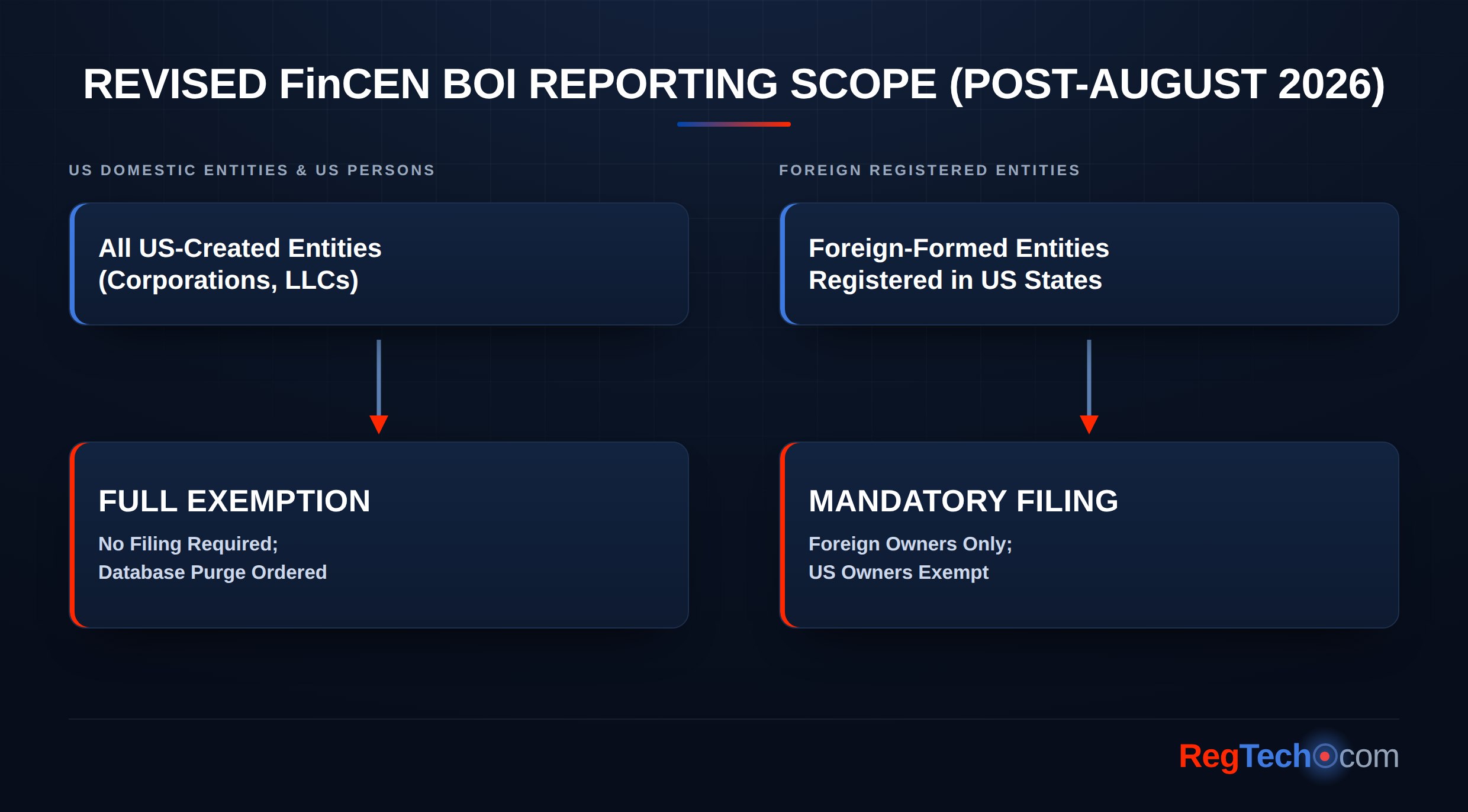
FinCEN's final rule permanently dismantles domestic beneficial ownership reporting obligations under the Corporate Transparency Act. Under the updated regulatory framework, all entities incorporated or created within the United States previously categorised as domestic reporting companies, alongside US person beneficial owners and company applicants, are fully exempt from filing BOI reports.
In tandem with the exemption, FinCEN confirmed it will delete all historical BOI submissions made by now-exempt domestic companies, company applicants, and US individuals from its database. Reporting requirements are now confined strictly to foreign entities registered to conduct business within US jurisdictions, provided they do not meet an existing statutory exemption.
What Affected Businesses and Individuals Must Know
For Domestic Companies and US Individuals
All filing deadlines, annual updates, and operational tracking associated with FinCEN BOI compliance for domestic entities are nullified. US persons serving as beneficial owners, officers, or company applicants are not required to disclose personally identifiable information (PII), such as passport copies or residential addresses, to FinCEN or to foreign reporting companies. US persons who previously obtained a FinCEN ID are permanently released from the ongoing 30-day obligation to update or correct their personal information.
For Foreign Entities Registered in the US
Foreign corporations and limited liability companies registered to conduct business within US states must evaluate their classification. If a foreign entity does not qualify for one of the statutory exemptions (such as the large operating company or regulated financial institution exemptions), it must file a BOI report containing verified corporate details, legal trade names, foreign jurisdiction of formation, US business address, and IRS Taxpayer Identification Number (TIN/EIN) alongside verified information for its foreign beneficial owners and foreign company applicants. Any US person holding equity, exercising substantial control, or acting as a company applicant for such foreign entities must be excluded from the report.
Step-by-Step Action Plan: How to Proceed Now and in the Future
Immediate Operational Adjustments and Fraud Vigilance
Internal legal, compliance, and accounting teams should immediately terminate all internal projects, third-party software subscriptions, and compliance workflows dedicated to domestic CTA reporting. Multinationals and cross-border enterprises must review all foreign subsidiaries registered in US states to confirm whether active state registrations require a specialised foreign entity BOI submission. Corporate secretaries and legal counsel should revise client engagement letters to reflect the removal of CTA compliance obligations for domestic vehicles. Additionally, business owners must remain vigilant against fraudulent correspondence claiming that BOI filings remain mandatory or requesting administrative fees. FinCEN does not charge filing fees, nor does it send payment demands or require individuals to submit formal deletion requests.
Data Handling Protocols and State-Level Legislative Monitoring
FinCEN will perform a one-time sweep of its database in coordination with NARA to remove records associated with US companies, domestic beneficial owners, and domestic company applicants. No individual confirmation notices will be issued to filers, though public completion will be announced on FinCEN's website. Crucially, if domestic BOI is inadvertently submitted in filings made 180 days post-publication, FinCEN does not anticipate undertaking subsequent deletions. Finally, while federal domestic obligations under the CTA have been eliminated, corporate officers must monitor individual state legislatures. State-level transparency frameworks such as the New York LLC Transparency Act operate under independent statutory authority and may still impose localised transparency requirements.
Comparative Analysis: Statutory Scope Shift
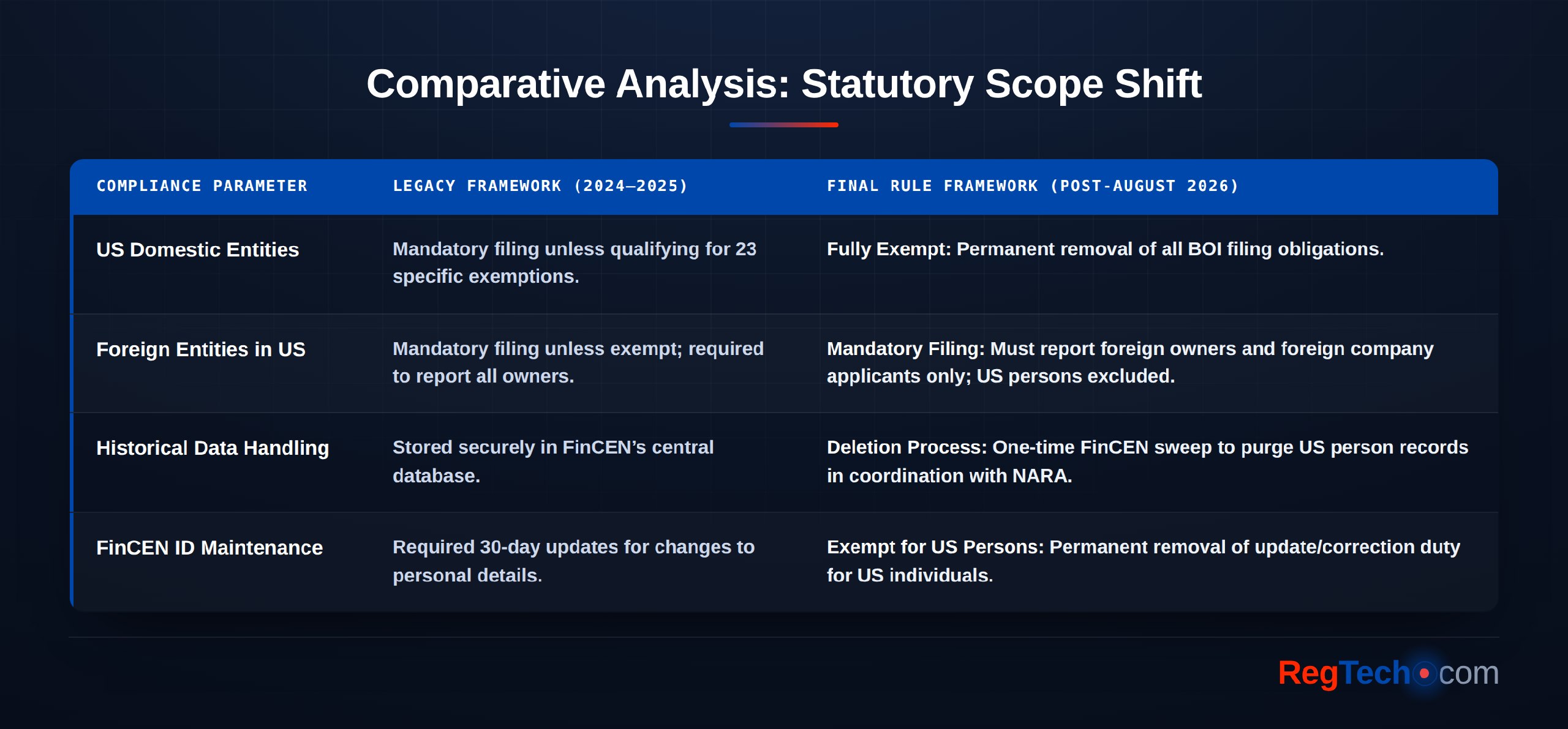
FinCEN’s permanent repeal of beneficial ownership reporting for domestic entities represents an unprecedented regulatory shift, relieving millions of American small businesses from administrative compliance burdens. By refocusing enforcement resources strictly on foreign entities registered in the US, federal authorities are prioritising foreign capital transparency while mitigating privacy concerns for domestic enterprises.
For compliance officers and corporate advisers, the immediate priority shifts toward terminating redundant domestic reporting overhead, verifying foreign entity registration statuses, and ensuring corporate governance procedures remain aligned with evolving state-level requirements.
Read the official FinCEN release here.