
On 13 August 2026, the Tánaiste and Minister for Finance, Simon Harris, launched Ireland’s first National Anti-Money Laundering (AML), Countering the Financing of Terrorism (CFT) and Countering Proliferation Financing Strategy, published by the Department of Finance. The strategy sets a government direction for tackling illicit finance through to 2030 and, for the first time, places crypto-assets and cross-border risk at the centre of Ireland’s financial crime defences.
The strategy is built on Ireland’s 2026 National Risk Assessment for money laundering, terrorist financing and proliferation financing, and it arrives as the European Union’s new anti-money-laundering package, the single rulebook and the Anti-Money Laundering Authority (AMLA) in Frankfurt, moves toward full application. It also prepares Ireland for its next mutual evaluation by the Financial Action Task Force (FATF), whose reviews carry heavy weight for a jurisdiction’s standing as an international financial centre.
Five priorities to 2030
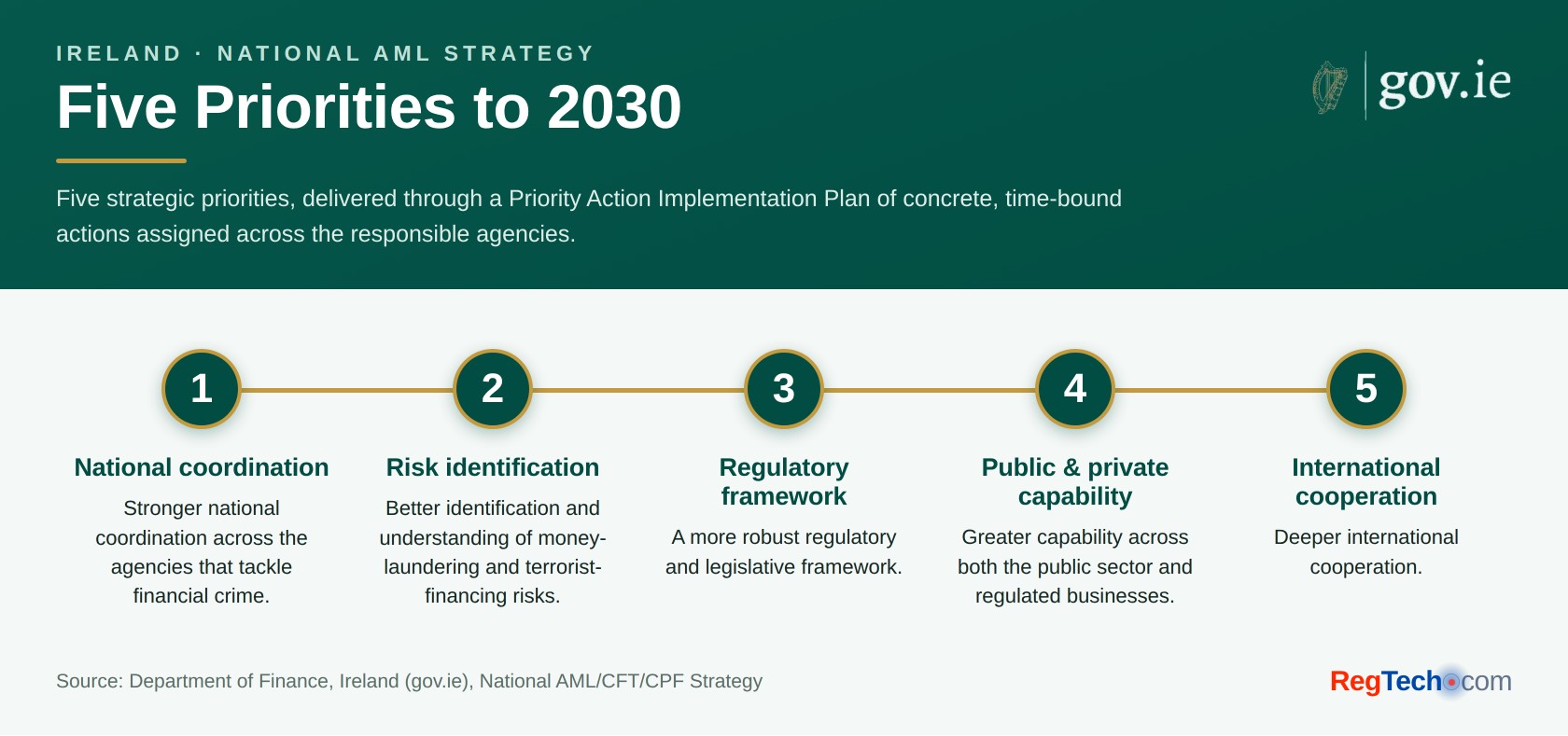
The most consequential shift for financial services is tighter rules on crypto. The strategy commits Ireland to strengthen anti-money laundering rules for crypto-assets and crypto transfers, in its own words, “making it more difficult for criminals to move illicit funds anonymously”. Operationally, this subjects crypto-asset service providers to stricter requirements, such as rigorous scrutiny of transactions linked to unhosted wallets and heightened due diligence for engagements with foreign crypto entities.
It is a deliberate move against anonymity in digital-asset flows, and it aligns Ireland with the direction the EU has already set through its single rulebook and travel-rule requirements for crypto transfers. (The Government’s language is “overseas” rather than “offshore”, but the concern is the same: cross-border chains that can obscure the origin of funds.)
The European Union’s Anti-Money Laundering Regulation will impose a single, directly applicable rulebook across member states, harmonised customer due diligence, tighter beneficial-ownership rules and an EU-wide cap on large cash payments, while AMLA, being stood up in Frankfurt, will oversee the highest-risk firms later this decade.
What it means for compliance teams
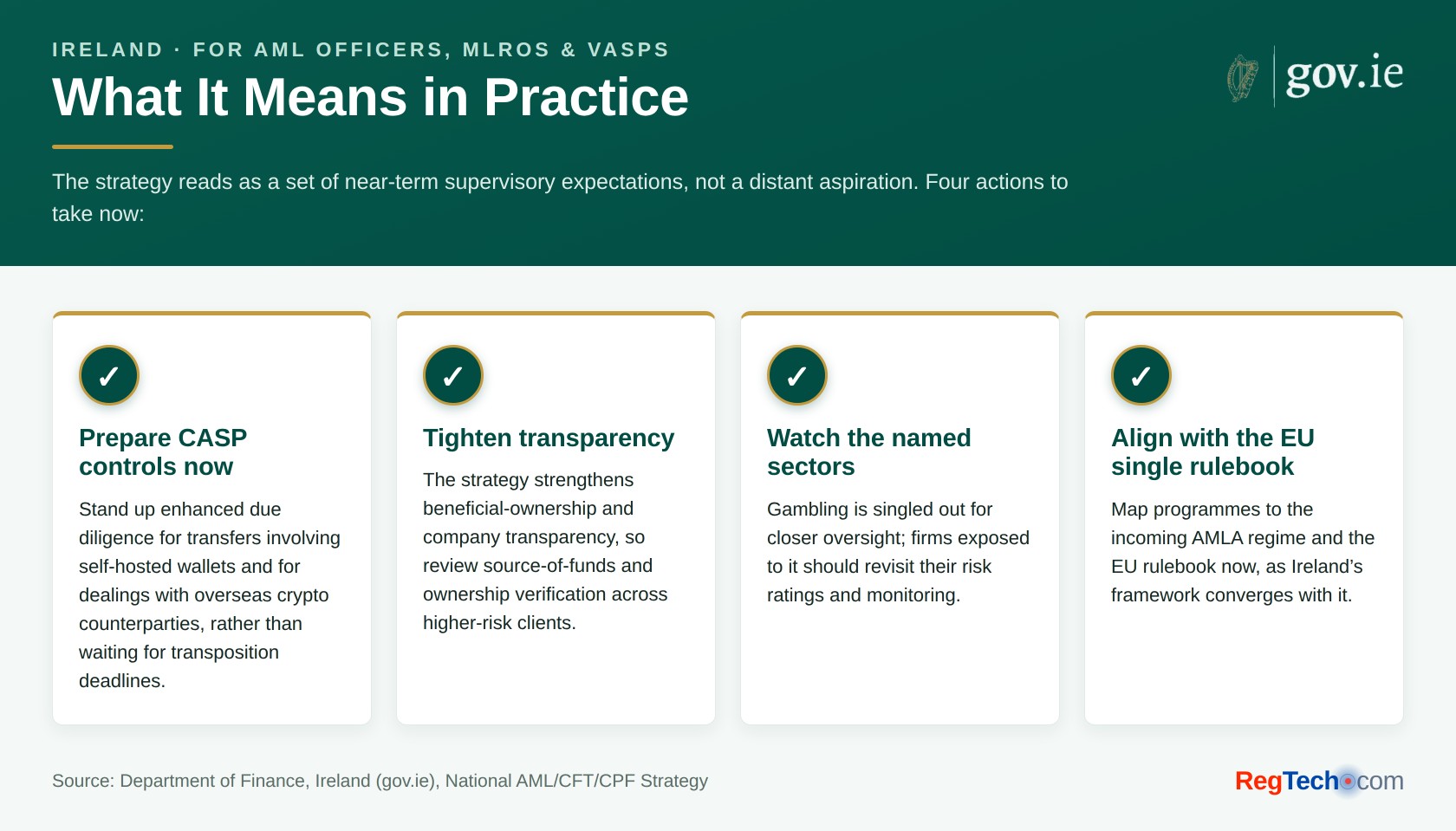
The strategy also lands against a backdrop of tougher enforcement across Europe, from multi-million-euro fines for monitoring failures to the expansion of AML obligations to new gatekeeper sectors elsewhere. The common thread is a shift from box-ticking to demonstrable effectiveness; supervisors increasingly want evidence that controls actually disrupt illicit flows.
Ireland’s first national strategy signals that financial-crime policy is now a coordinated, government priority rather than a compliance afterthought, with crypto squarely in scope. With the FATF evaluation ahead and the EU’s single rulebook bearing down, the institutions that move early, tightening crypto due diligence, beneficial-ownership checks and cross-border controls, will be the ones best placed when the new expectations become binding.
Read the full Department of Finance announcement and the strategy publication for the details.