On 5 August 2026, Deputy Prime Minister, Minister for Trade and Industry, and Chairman of the Monetary Authority of Singapore (MAS) Mr Gan Kim Yong provided a written parliamentary response addressing the regulation of Virtual Asset Service Providers (VASPs).
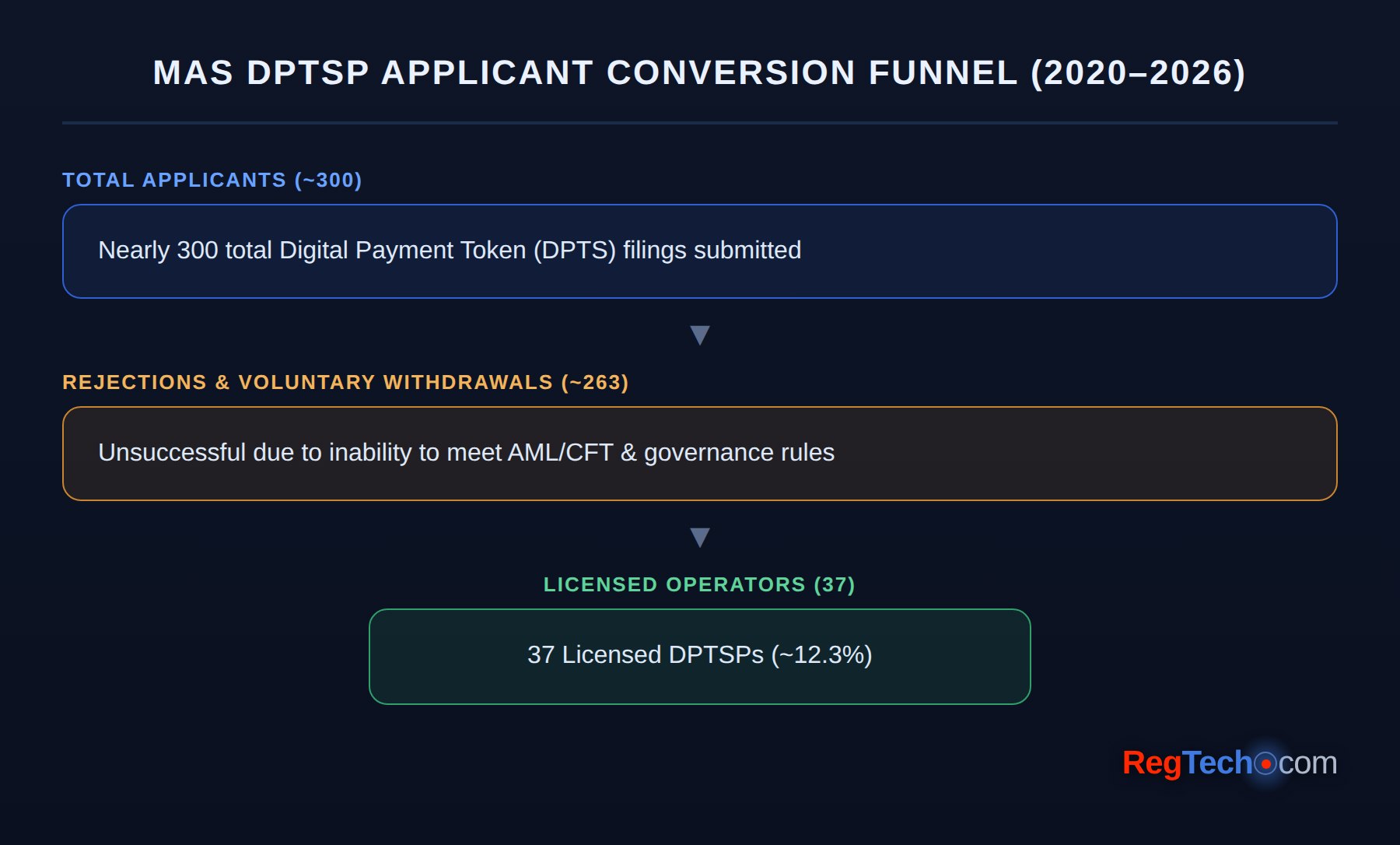
The response revealed that since Singapore’s regulatory framework under the Payment Services Act (PSA) took effect in 2020, MAS has granted licenses to 37 Digital Payment Token Service Providers (DPTSPs) out of nearly 300 total applicants, reflecting an approval rate of approximately 12.3%. The vast majority of remaining applications were either formally rejected by MAS or voluntarily withdrawn after firms concluded they could not fulfil regulatory compliance expectations.
Strategic Implications for Market Participants
For institutional counterparties, local banking partners, and international prime brokers, securing a Major Payment Institution (MPI) license for Digital Payment Token (DPT) services from the Monetary Authority of Singapore (MAS) has become a premier global benchmark. The rigorous application process turns obtaining the authorisation into a value proposition, signalling that an operator possesses institutional-grade stability and compliance frameworks. Under MAS requirements, licensed entities must adhere to strict safeguarding and governance rules.
This includes maintaining customer asset segregation, storing funds in independent trust accounts within Singapore, and establishing technology risk management controls to protect digital assets. Furthermore, regulatory oversight extends beyond initial approval; MAS maintains proactive enforcement, conducts sector-wide threat reviews, and enforces post-licensing audits to ensure ongoing compliance.
Retail participants operating on an MAS-licensed exchange benefit from heightened consumer protections designed to prevent the commingling of customer funds and ensure operational resilience. These bank-grade asset segregation rules are coupled with strict conduct restrictions designed to curb public speculation. To safeguard retail consumers, licensed providers are explicitly prohibited from offering credit lines, leverage, or credit card-funded cryptocurrency purchases. Ultimately, retail investors are continuously reminded that utilising offshore or unregulated platforms operating without an MAS license leaves them exposed to severe financial risks, as these unauthorised entities carry no statutory protections under Singapore law.
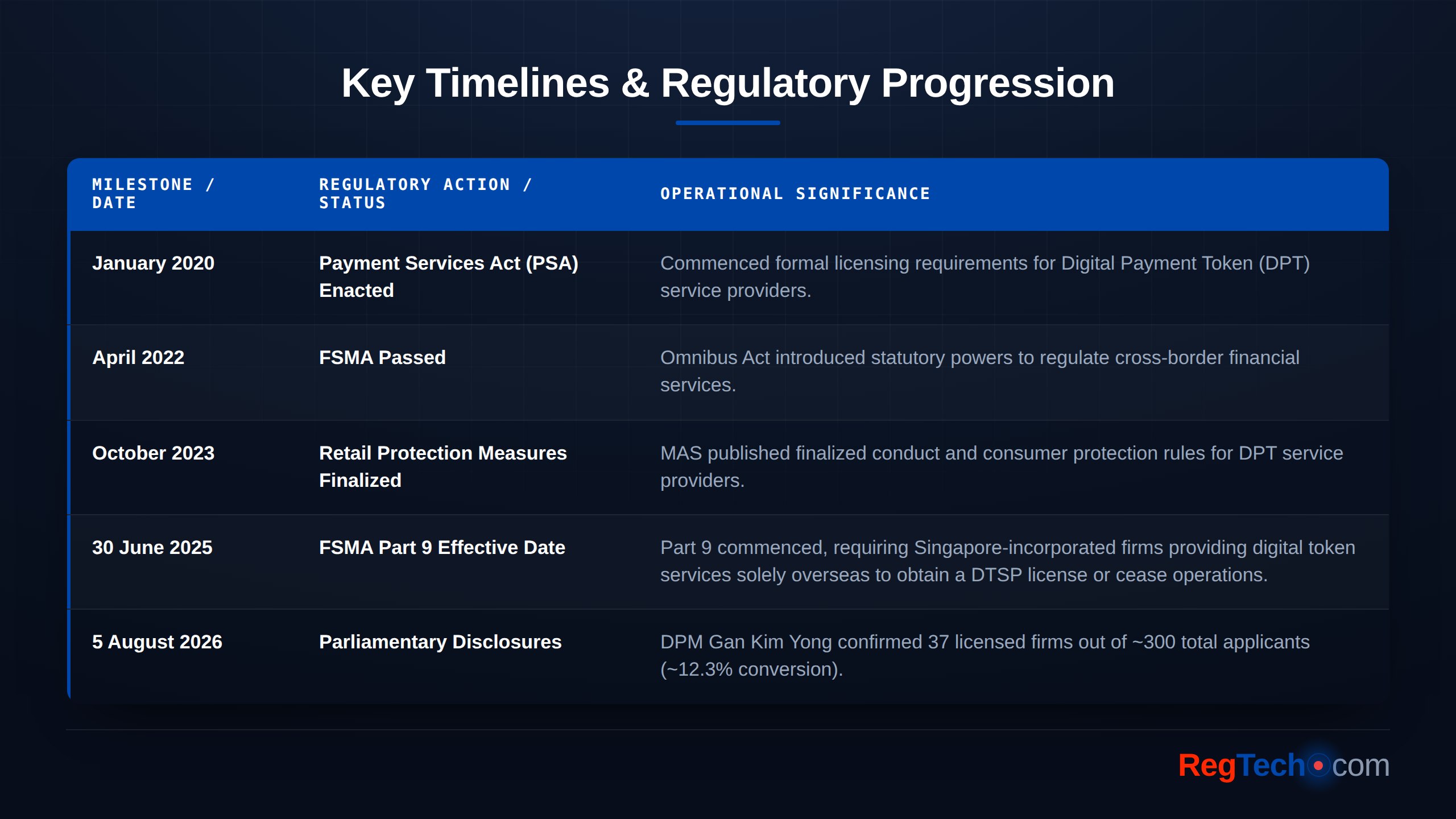
Key Timelines & Regulatory Progression
Critical Highlights & Strategic Friction Points
- Shift from "Crypto Hub" to "Anchored Digital Asset Hub": Singapore's strategy deliberately filters out high-risk or purely speculative crypto operators, favouring institutional-grade infrastructure providers, stablecoin issuers, and institutional custodians.
- FSMA Part 9 Enforcement Impact: The June 2025 commencement of Part 9 of the Financial Services and Markets Act (FSMA) eliminated regulatory arbitrage for Singapore-incorporated entities operating exclusively offshore, accelerating application withdrawals from non-compliant entities.
- Cross-Border Intelligence & COSMIC Alignment: MAS continues to integrate DPT risk monitoring with domestic intelligence initiatives such as expanding the COSMIC financial crime data-sharing platform to combat transnational money laundering networks.
Expert Analysis: What to Expect Next from MAS
Industry compliance experts and regulatory attorneys expect the following developments in upcoming parliamentary and regulatory sessions:
- Expectation 1: Formalisation of Stablecoin Framework Rules: Following previous consultations, MAS is expected to finalise specific reserve asset and operational requirements for single-currency stablecoin (SCS) issuers seeking regulatory recognition.
- Expectation 2: AI & Agentic Risk Guidance: As highlighted in recent MAS updates, financial institutions and DPT providers will face principles-based expectations regarding the deployment of Artificial Intelligence (AI) and automated agents in trading and compliance workflows.
- Expectation 3: Heightened Focus on Proliferation Financing: Given evolving geopolitical tensions, MAS and FATF will place increased scrutiny on cross-border crypto flows involving dual-use technology and sanctioned jurisdictions.
The disclosure that fewer than 13% of applicants have secured a DPT license demonstrates that Singapore's regulatory strategy prioritises long-term systemic stability over sheer market volume. For web3 and regtech executives, MAS’s rigorous stance reaffirms that doing business in Singapore requires substantial local presence, robust compliance infrastructure, and uncompromising AML/CFT controls. As global regulators align with FATF standards, Singapore’s 37 licensed firms represent a hardened, institutional cohort poised to define the future of Asia's digital asset economy.
Read the full parliamentary reply here.