
On 10 August 2026, the US Securities and Exchange Commission (SEC) charged New York-based private fund adviser Adit Ventures Management LLC, its CEO Eric Munson, and three affiliated general partners (Adit Ventures LLC, Adit Ventures II LLC, and Adit Ventures III LLC) in the US District Court for the Southern District of New York.
The Commission's complaint alleges a pervasive, multi-year fraudulent scheme operating from at least April 2019 through December 2024. Centred around high-profile pre-IPO secondary investments in companies such as SpaceX and Klarna, the defendants allegedly misappropriated client assets, collected millions in unauthorised fees, engaged in illicit self-dealing, and failed to register as an investment adviser.
Without admitting or denying the allegations, the defendants consented to entry of judgments permanently enjoining them from violating federal securities laws, with disgorgement, prejudgment interest, and civil penalties to be determined by the court. CEO Eric Munson further agreed to an associational bar with a right to reapply after three years.
Key Executive Takeaways
- Strict Fiduciary Enforcement in Secondary Markets: The SEC's Asset Management Unit is actively targeting private fund advisers that exploit retail and institutional enthusiasm for pre-IPO secondary shares (such as SpaceX and Klarna) to execute covert fee extraction and price markups.
- Core Antifraud Violations: The complaint establishes clear breaches of the Securities Act of 1933, the Securities Exchange Act of 1934, and the Investment Advisers Act of 1940 (specifically Sections 206(1), 206(2), 206(3), and 206(4)).
- Registration Arbitrage Shutdown: Adit Ventures Management’s failure to register as an investment adviser highlighted a fundamental compliance deficit, demonstrating that operating as an exempt or unregistered manager offers no immunity from SEC antifraud provisions.
- Cross-Border Regulatory Intelligence: The SEC formally acknowledged assistance from the Jersey Financial Services Commission (JFSC), underlining the cross-border coordination deployed to trace offshore fund structures and asset pledges.
Analysing Compliance & Legal Breaches
The enforcement action against Adit Ventures illustrates several textbook violations of the Investment Advisers Act of 1940 and foundational fiduciary principles:
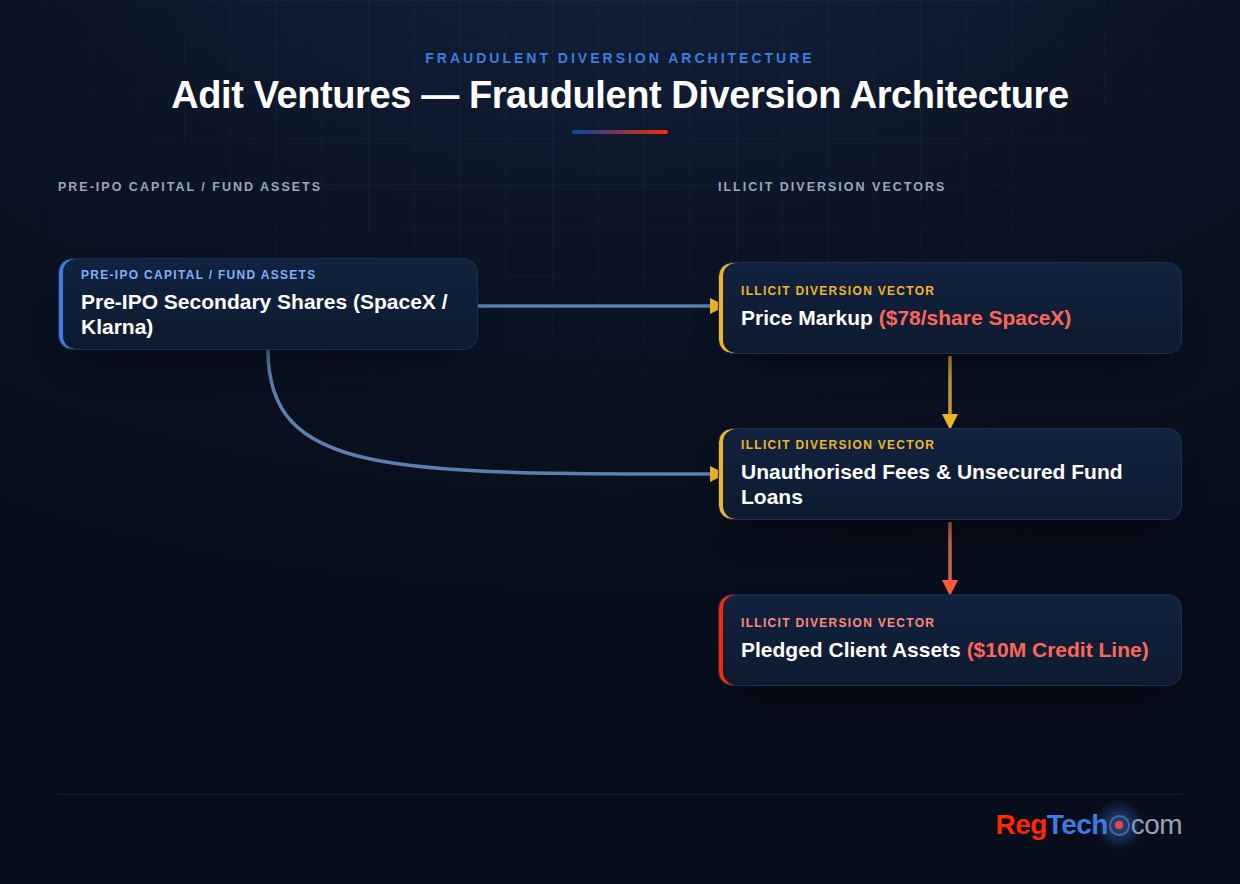
1. Undisclosed Principal Transactions & Secondary Price Markups
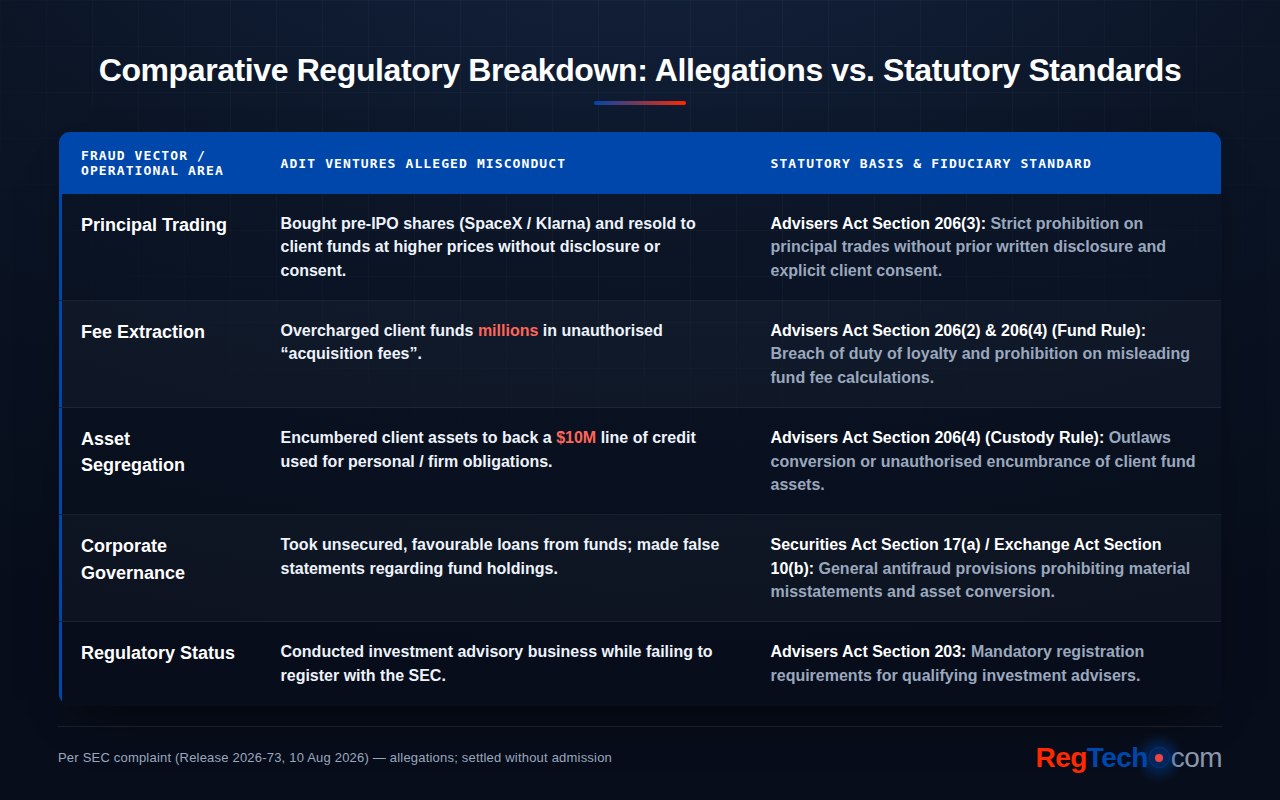
Under Section 206(3) of the Advisers Act, an adviser acting as a principal for their own account cannot knowingly sell securities to or purchase securities from a client without providing detailed written disclosure and obtaining client consent prior to transaction completion. The SEC alleges the defendants purchased pre-IPO shares directly and subsequently caused Adit-managed client funds to purchase those exact shares at a marked-up price—such as acquiring SpaceX shares at a $78 per share markup—while misrepresenting the true acquisition cost and concealing their principal interest.
2. Unauthorised "Acquisition Fees" & Misappropriation
Advisers are bound by the terms set forth in their Limited Partnership Agreements (LPAs) and Private Placement Memorandums (PPMs). Adit Ventures allegedly siphoned millions of dollars directly out of client funds under the guise of unauthorised "acquisition fees" that were neither permitted by fund governing documents nor disclosed to investors.
3. Unauthorised Collateral Pledges & Credit Line Self-Dealing
Addressing a major area of regulatory concern regarding client asset segregation, the complaint alleges that the defendants pledged client fund assets as collateral to secure a $10 million line of credit. Proceeds from this credit facility were allegedly diverted to settle personal and corporate liabilities, directly exposing client assets to third-party lender encumbrances.
4. Unsecured "Self-Funded" Loans & False Holdings Claims
The complaint details how the defendants regularly took unsecured loans from client funds on highly favourable terms without authorisation or disclosure. Furthermore, CEO Eric Munson directly solicited investor capital by falsely asserting that an Adit fund owned shares in specific pre-IPO companies when no such positions existed.
Comparative Regulatory Breakdown: Allegations vs. Statutory Standards
Valuation Governance and Pre-Trade Principal Protocols
Private equity and venture capital managers operating within secondary pre-IPO markets must establish robust, independent valuation committees. Transferring assets between general partners, affiliated entities, and fund vehicles mandates independent third-party valuation verification to prevent artificial price markups. In parallel, compliance management systems (CMS) must be configured to automatically flag and block any transaction where an adviser, general partner, or affiliate acts as a counterparty. Automated trade-surveillance workflows should strictly require documented Limited Partner Advisory Committee (LPAC) consent and explicit written disclosures prior to trade execution.
Custodial Oversight and Credit Facility Disclosure Standards
Institutional gatekeepers, including prime brokers, fund administrators, and custodians, must enforce automated verification checks to ensure client assets cannot be pledged or encumbered for credit lines benefiting management entities. Fund administrators bear a crucial responsibility to independently reconcile Limited Partnership Agreement (LPA) fee schedules against capital calls and disbursements, preventing unauthorised fee deductions. Furthermore, advisers must ensure that any borrowing, inter-fund lending, or credit facility arrangement is explicitly permitted under governing LPA terms, fully disclosed to the LPAC, and subjected to rigorous arms-length execution standards.
The SEC’s action against Adit Ventures serves as a clear warning to private equity and venture capital managers navigating pre-IPO secondary markets. High investor demand for late-stage private technology shares does not exempt advisers from fundamental fiduciary standards.
As the SEC Asset Management Unit expands its oversight of private funds, compliance teams and fund gatekeepers must conduct thorough reviews of their principal transaction policies, valuation methodologies, and credit line collateral structures. Regulated managers that fail to maintain transparent fee schedules, robust valuation controls, and strict asset segregation will face immediate enforcement action, reputational damage, and statutory industry bars.
Read the full SEC press release here.