Passage of Taiwan’s Virtual Asset Service Act (VASA) on 30 June 2026; transition from AML registration to a full 7-category FSC licensing framework; dual FSC–Central Bank consent for stablecoins with 100% segregated domestic trust reserves.
Taiwan Enacts Virtual Asset Service Act: Mandatory FSC Licensing Replaces AML-Only Regime
Taiwan’s Legislative Yuan completed the third reading of the Virtual Asset Service Act (VASA) on 30 June 2026, creating the jurisdiction’s first statutory framework for digital assets.
The legislation fundamentally alters the regulatory structure governing domestic cryptocurrency firms. Rather than relying on a patchwork of anti-money laundering (AML) compliance filings, the new law establishes a comprehensive licensing regime enforced by the Financial Supervisory Commission (FSC).
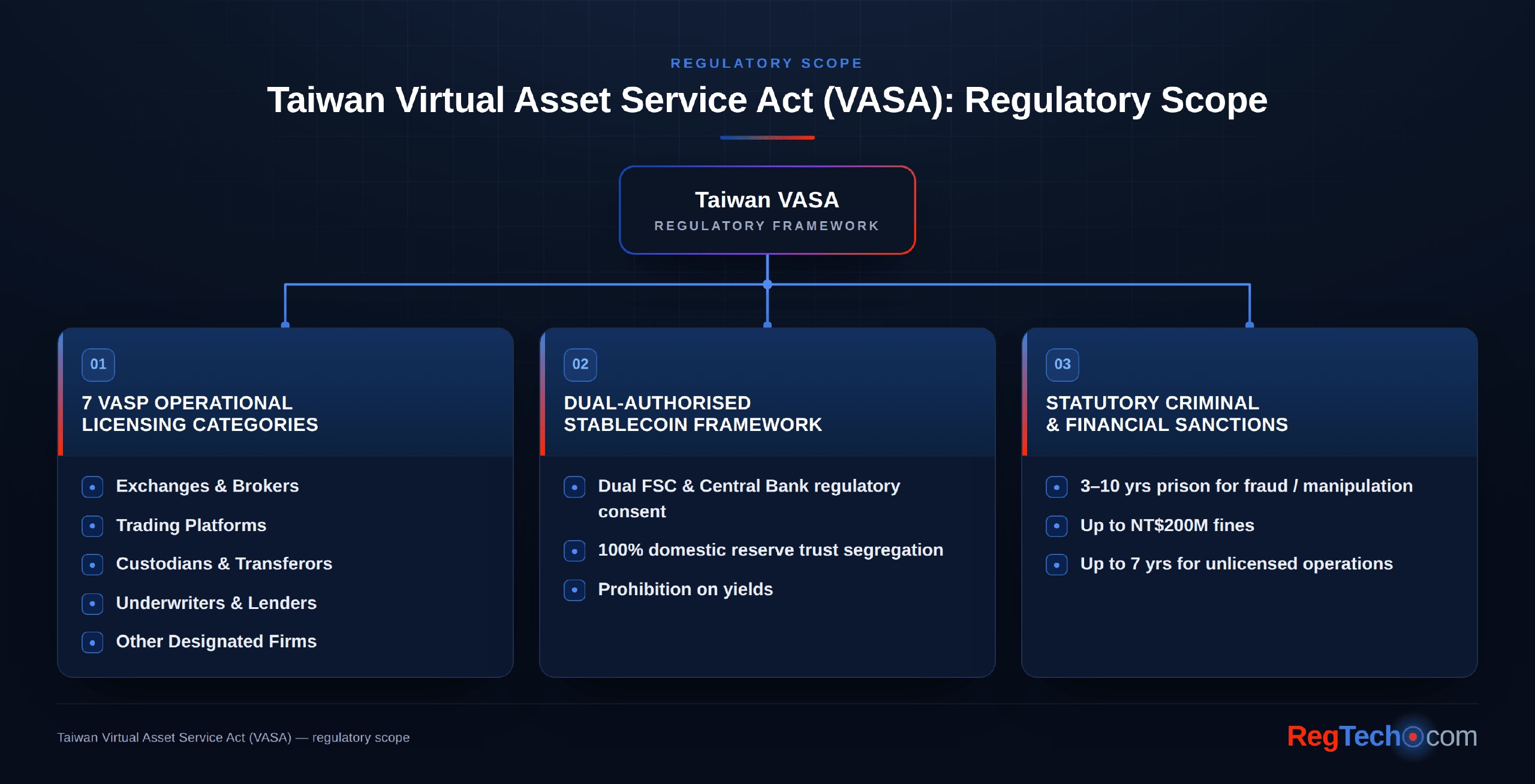
Statutory oversight replaces self-regulation as Taiwan passes a comprehensive crypto statute.
Expanding Statutory Scope Beyond AML Registration
Previously, entities offering digital asset services in Taiwan operated under an AML compliance framework administered by the FSC. Under VASA, statutory oversight expands from basic financial crime monitoring to comprehensive operational supervision.
The statute explicitly defines seven categories of Virtual Asset Service Providers (VASPs): exchange operators, trading platform operators, transfer providers, custodians, underwriters, and lending providers, together with a catch-all category covering other virtual asset services designated by the FSC.
Entities operating within these categories must obtain formal FSC authorisation before commencing business operations. Licensed firms will be subject to statutory requirements covering:
- Asset Protection: Mandatory segregation of corporate assets from customer funds, supported by independent trust accounts.
- Operational Controls: Audited internal control mechanisms, business continuity protocols, and standardized token listing and delisting evaluation committees.
- Governance & Security: FSC-approved qualifications for senior officers, financial reporting rules, and rigorous cybersecurity management baselines.
Dual Consent Framework for Fiat-Referenced Stablecoins
VASA introduces a purpose-built regulatory regime for stablecoins pegged to fiat currencies.
Issuers seeking to deploy stablecoins in or from Taiwan must secure dual approval from both the FSC and the Central Bank of the Republic of China (Taiwan).
To protect holders against insolvency risks, issuers must maintain unencumbered, 100% reserve backing placed in trust with domestic financial institutions. Reserve assets are legally segregated from the issuer’s general bankruptcy estate, providing stablecoin holders with priority claims in liquidations.
Furthermore, the statute explicitly prohibits stablecoin issuers from paying interest, yields, or other financial returns to holders and mandates regular external audits of reserve backing.
Severe Criminal Penalties and Market Conduct Enforcements
Unlike administrative infractions under prior guidance, VASA introduces substantial criminal liability to deter illicit operations and market abuse:
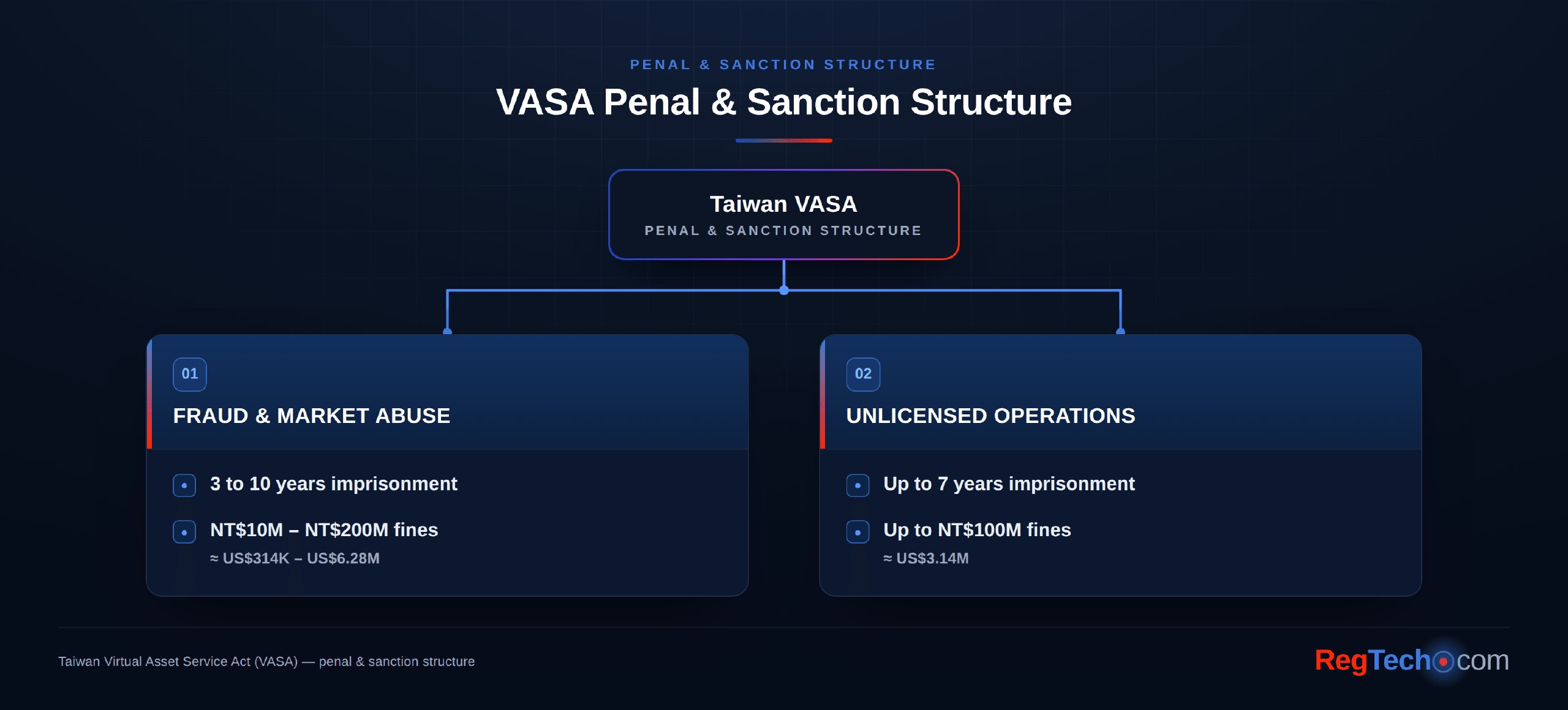
Penal provisions of 3–10 years’ imprisonment and NT$10M–NT$200M fines for fraud/manipulation; 12-month application and 21-month approval transition windows for existing entities.
- Market Manipulation & Fraud: Individuals engaging in fraudulent misrepresentation or manipulating virtual asset prices, supply, or market demand face 3 to 10 years’ imprisonment and criminal fines ranging from NT$10 million to NT$200 million (approx. US$314,000 to US$6.28 million).
- Unlicensed Activity: Operating a VASP or issuing stablecoins without statutory approval carries up to 7 years’ imprisonment and fines up to NT$100 million.
Transition Architecture and Implementation Roadmap
Following legislative approval, the Executive Yuan will proclaim the formal commencement date.
Existing VASPs that completed prior AML registrations before the statute’s effective date are granted a structured transition window:
- Application Window: Entities must formally submit a licensing application to the FSC within 12 months of the law coming into effect.
- Approval Deadline: Applicants must secure full statutory licensing within 21 months of the effective date to continue operating legally.
Concurrently, lawmakers passed a non-binding supplementary resolution requesting the FSC to present a plan within one year detailing how virtual asset firms might offer regulated derivative products.
Upcoming Updates on VASA:
- Secondary Implementing Rules: Detailed technical guidelines regarding capital requirements, custody architecture, and specific Travel Rule thresholds remain to be published by the FSC.
- Foreign VASP Perimeter: The exact statutory conditions under which offshore exchanges must establish domestic subsidiaries to serve Taiwanese counterparties have not been fully clarified in the primary text.