
The United States digital asset industry stands at a decisive regulatory crossroad. In an overnight session immediately preceding the August congressional recess, Senate Majority Leader John Thune filed cloture on the motion to proceed to H.R. 3633, the Digital Asset Market Clarity Act (the CLARITY Act). Executed at 4:52 a.m. ET on Saturday, 8 August 2026, this procedural manoeuvre officially queues up the bill as the Senate's top legislative priority when lawmakers reconvene in mid-September.
The filing establishes a firm date for the chamber's first formal vote: Tuesday, 15 September 2026, at 2:15 p.m. ET. Introduced to establish comprehensive guardrails for digital asset markets, the CLARITY Act constructs a federal regulatory architecture by drawing clear jurisdictional boundaries between the Securities and Exchange Commission (SEC) and the Commodity Futures Trading Commission (CFTC). However, clearing the Senate’s 60-vote filibuster threshold will require delicate bipartisan manoeuvring over unresolved ethics addendums, stablecoin yield restrictions, and banking deposit protections.
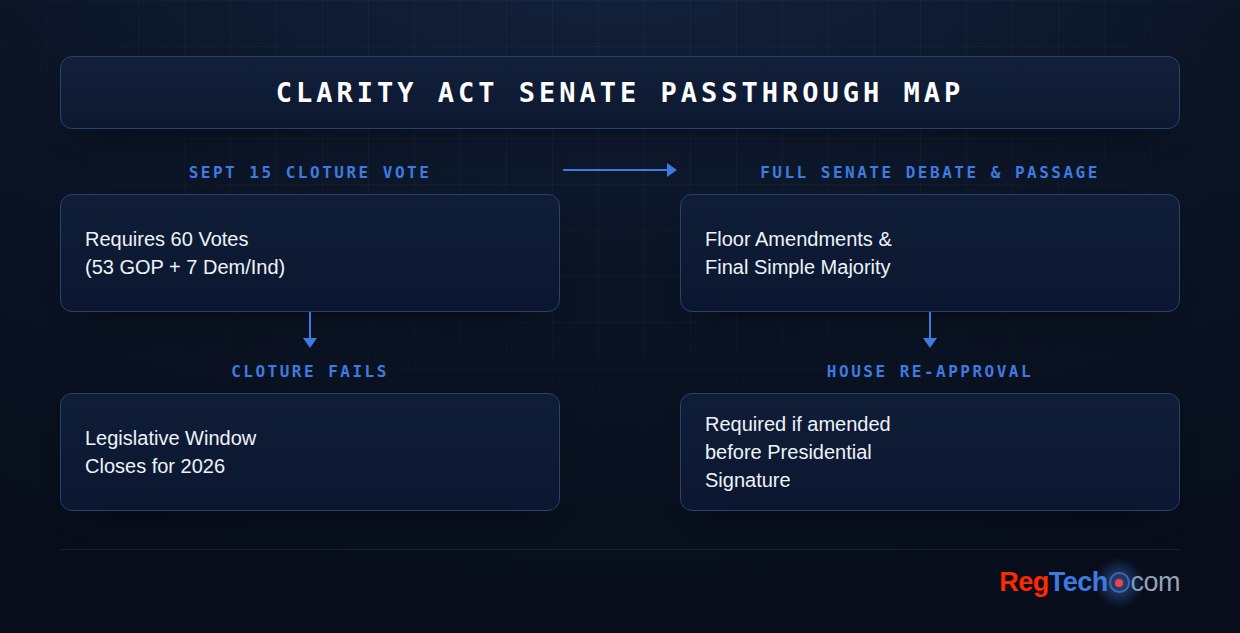
Core Takeaways & Procedural Reality
- Procedural Priority Secured: Leader Thune’s cloture filing on the motion to proceed initiates the multi-step parliamentary mechanism required to overcome filibuster delays and bring H.R. 3633 to floor debate.
- The 60-Vote Bipartisan Math: With Republicans holding 53 Senate seats, bill sponsors must secure at least 7 to 8 Democratic or Independent crossover votes to invoke cloture.
- Motion to Proceed vs. Final Passage: Invoking cloture on 15 September opens formal floor debate and amendment voting; it does not constitute final passage of the bill.
- Final 2026 Window: With the November 2026 midterm elections fast approaching, failure to clear the procedural vote in September will likely extinguish legislative momentum until 2027.
What Retail Investors and Institutions Need to Know
The proposed market structure introduces structural shifts for both institutional capital deployers and baseline retail users.
Institutional Outlook
For institutional custodians, asset managers, and market makers, the bill establishes long-sought statutory certainty. Primary spot market oversight for digital commodities is assigned to the CFTC, limiting SEC jurisdiction to digital asset securities and capital-raising activities. This jurisdictional split provides tier-one financial institutions with explicit registration frameworks, qualified custody guidelines, and trade-reporting rules under the Bank Secrecy Act (BSA).
Retail Market Impact
For retail market participants, the legislation enforces bank-grade consumer safeguards, requiring registered digital commodity exchanges to maintain strict customer asset segregation and bankruptcy-remote trust accounts. Furthermore, Section 409 explicitly excludes non-custodial developers and open-source software contributors who publish or maintain protocol code without exercising direct control over customer funds.
Legislative Deadlines & Progression Timeline

Key Points of Debate Ahead of September
Negotiators are spending the August recess attempting to resolve three central friction points:
- Executive Ethics & Conflict Addendum: Senate Democrats have made passage conditional on strict government ethics rules restricting federal officials from issuing or profiting from digital assets. Negotiators are working on a White House-aligned addendum that would require President Donald Trump to divest from crypto-related business interests.
- Stablecoin Yield & Reward Rules: Lawmakers remain divided over yield-bearing stablecoins. Compromise drafts generally prohibit passive interest payouts on payment stablecoins while permitting activity-based rewards (e.g., staking, liquidity provision, and loyalty programs) that are not economically equivalent to bank deposit interest.
- Banking Deposit Flight: Several members of the Senate Banking Committee, including Sen. Josh Hawley (R-Mo.), have expressed concern that yield-generating digital assets could trigger deposit flights from regional commercial banks.
Expert Analysis: What to Expect from the Next Session
Industry forecasts regarding passage remain cautious. Galaxy Research recently reduced its probability estimate of the CLARITY Act becoming law in 2026 from 50% down to 30%, citing the compressed Senate calendar and election-year politics. Similarly, prediction markets (such as Kalshi) price 2026 enactment odds between 20% and 30%.
However, trade groups like the Crypto Council for Innovation (CCI) view cloture filing as a vital step forward, confirming active lobbying efforts across both sides of the aisle throughout August.
Potential September Outcomes
- Scenario A: Successful Cloture (High Catalyst): Clearing the 60-vote hurdle on 15 September demonstrates strong bipartisan consensus, moving the bill directly into floor debate and setting up final Senate passage by late September.
- Scenario B: Failed Cloture (Legislative Stall): If Republicans fail to secure seven Democratic crossover votes, the bill stalls, pushing market structure legislation into 2027 as midterm campaigns take over the calendar.
- Scenario C: Bipartisan Manager's Package: Negotiators successfully integrate the ethics addendum and stablecoin yield compromise during recess, allowing a modified manager’s amendment to clear cloture with a comfortable 65+ vote majority.
Compliance Impact
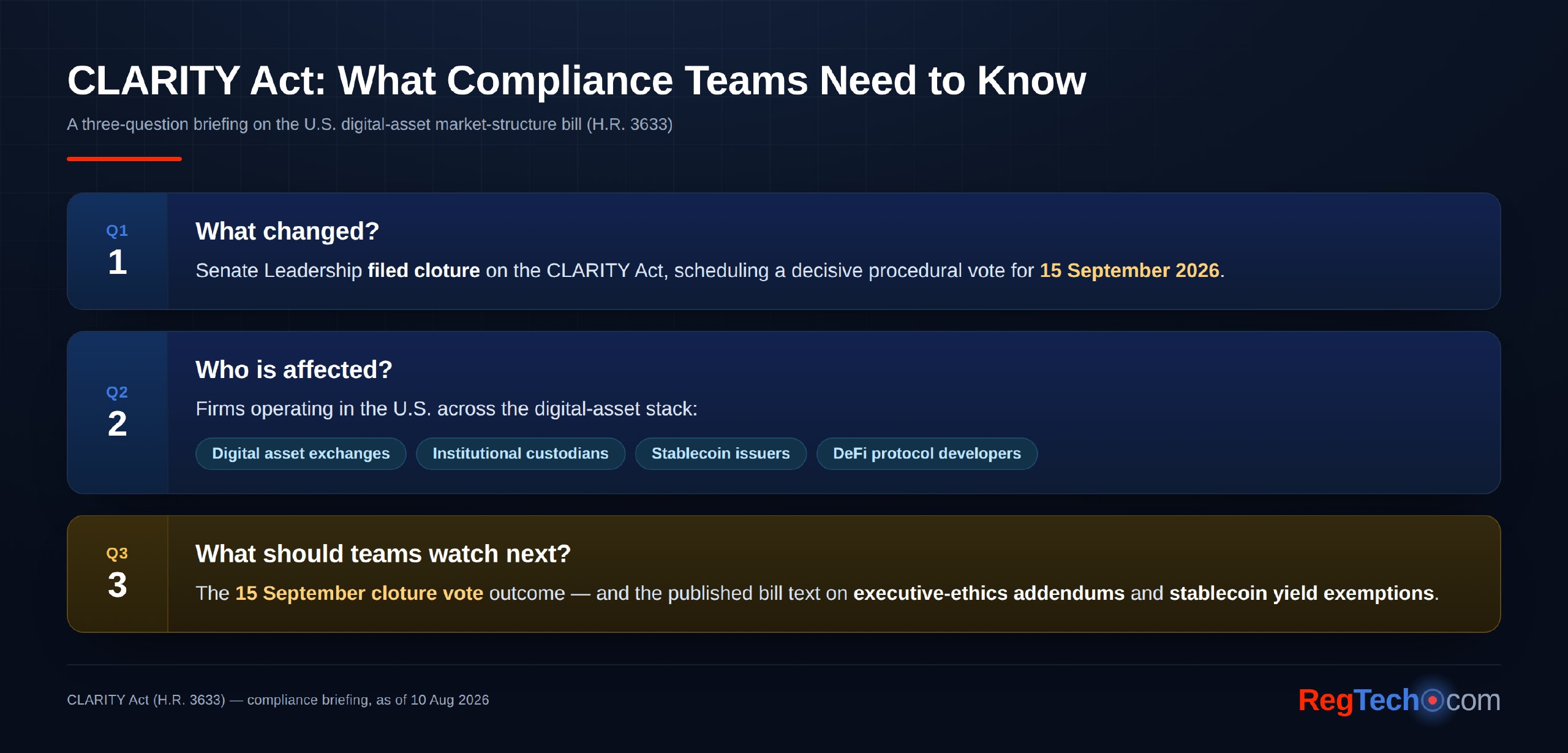
The filing of cloture on the CLARITY Act proves that comprehensive digital asset market structure remains a top priority for U.S. lawmakers. While procedural hurdles and election-year dynamics present significant friction, the 15 September vote represents a historical test for U.S. crypto regulation. Regulated institutions and compliance teams must monitor the upcoming Senate debate closely, preparing for a potential transition toward a dual SEC-CFTC oversight framework.