
Wise Group's shares fell after the US Office of the Comptroller of the Currency (OCC) rejected its national trust bank charter application. The rejection letter cited significant supervisory and compliance concerns, concluding that Wise’s anti-money laundering (AML) and countering the financing of terrorism (CFT) deficiencies failed to meet federal standards.
The Operational Challenge of Subsequent Remediation
In response to the OCC's decision, Wise stated that the rejection reflected 'historical issues' from its initial application, noting that those deficiencies have since been strengthened. The company also announced plans to seek access to federal payment networks by submitting a new application under the GENIUS Act, the federal payment stablecoin framework.
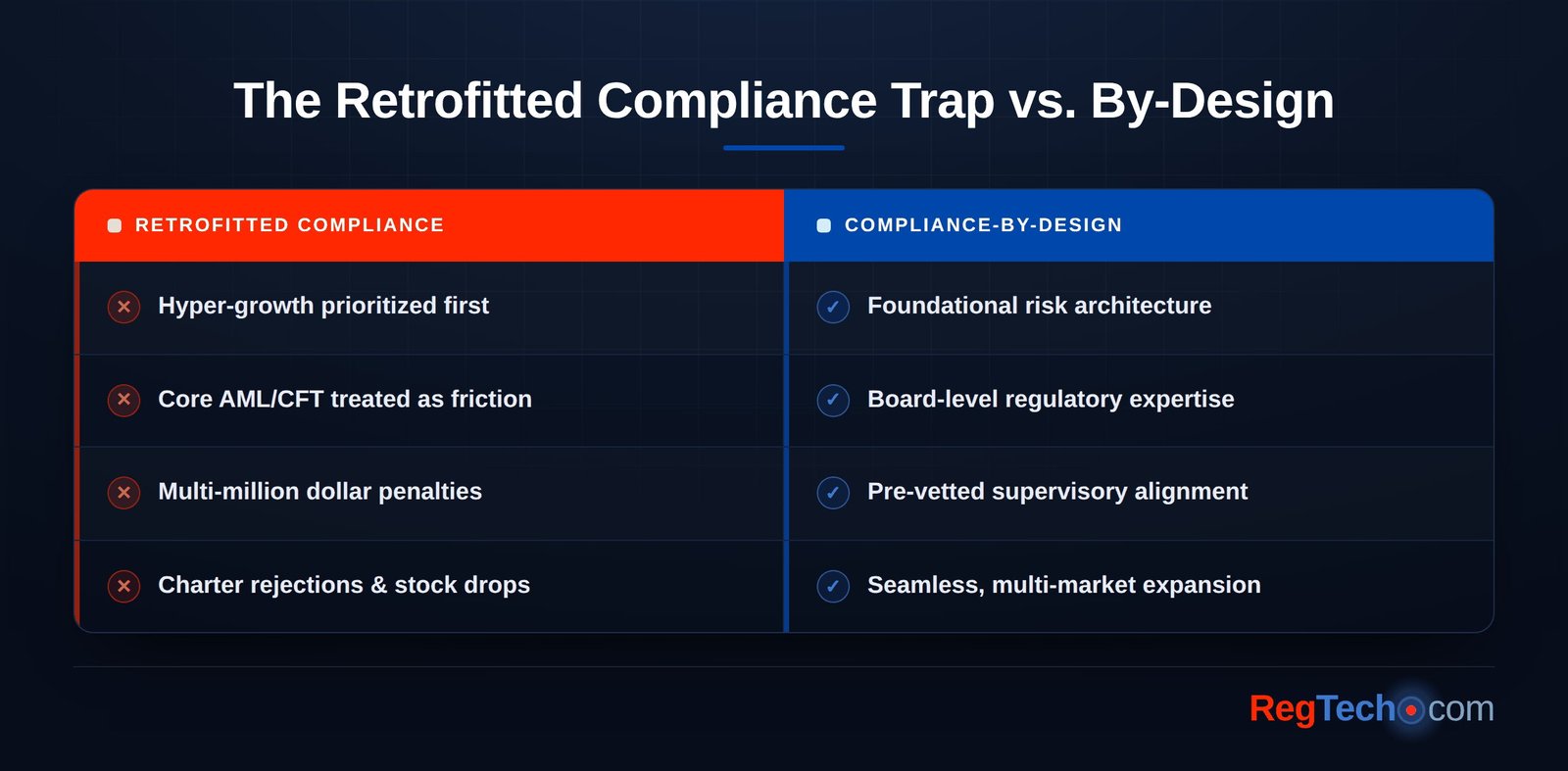
The post-application remediation below illustrates the operational friction that arises across the fintech sector when risk frameworks are updated alongside rapid commercial expansion rather than embedded from inception.
Prior Enforcement History & Regulatory Evaluation
Wise's US regulatory engagement includes previous enforcement history:
- Multi-State Settlement: Last year, Wise paid a $4.2 million penalty to settle state-level regulatory findings regarding Bank Secrecy Act (BSA) and AML program compliance. [New York Department of Financial Services Official Press Release]
- Cross-Border Inquiries: The company confirmed it was responding to information requests from Belgian authorities regarding transaction monitoring queries across European jurisdictions, noting that such requests are routine in global operations.
When an institution seeks to expand into high-barrier jurisdictions, regulators evaluate historical compliance records alongside current capacity.
Board Expertise as an Operational Requirement
Beyond platform-level AML systems, the OCC’s evaluation emphasised the composition of executive leadership. The watchdog noted in its letter that the proposed management team and board had not demonstrated sufficient prior experience in US banking law, fiduciary responsibilities, or national bank AML requirements.
This finding underlines a key standard enforced by banking regulators: regulatory approval requires both robust technical software and a governing board with expertise in statutory banking obligations.
Industry Implications
Wise continues to serve US customers under its existing money transmitter licenses valid across 48 states and four territories. However, operating without a national trust bank charter limits direct access to federal clearing networks, requiring continued reliance on partner banking institutions.
For institutional risk functions, the case offers three clear strategic takeaways:
- Compliance as Infrastructure: Operational software and competitive pricing engines must be matched by equal investment in core regulatory reporting ledgers.
- Timing of Capital Allocation: Upfront architectural compliance investment avoids the substantial legal costs, administrative delays, and market volatility associated with formal charter denials.
- Embedded Governance: Achieving long-term operational scale requires embedding regulatory expertise into board governance and system design from inception.
In an era of heightened regulatory enforcement across global markets, speed can get you to market, but only compliance-by-design will allow you to stay there.