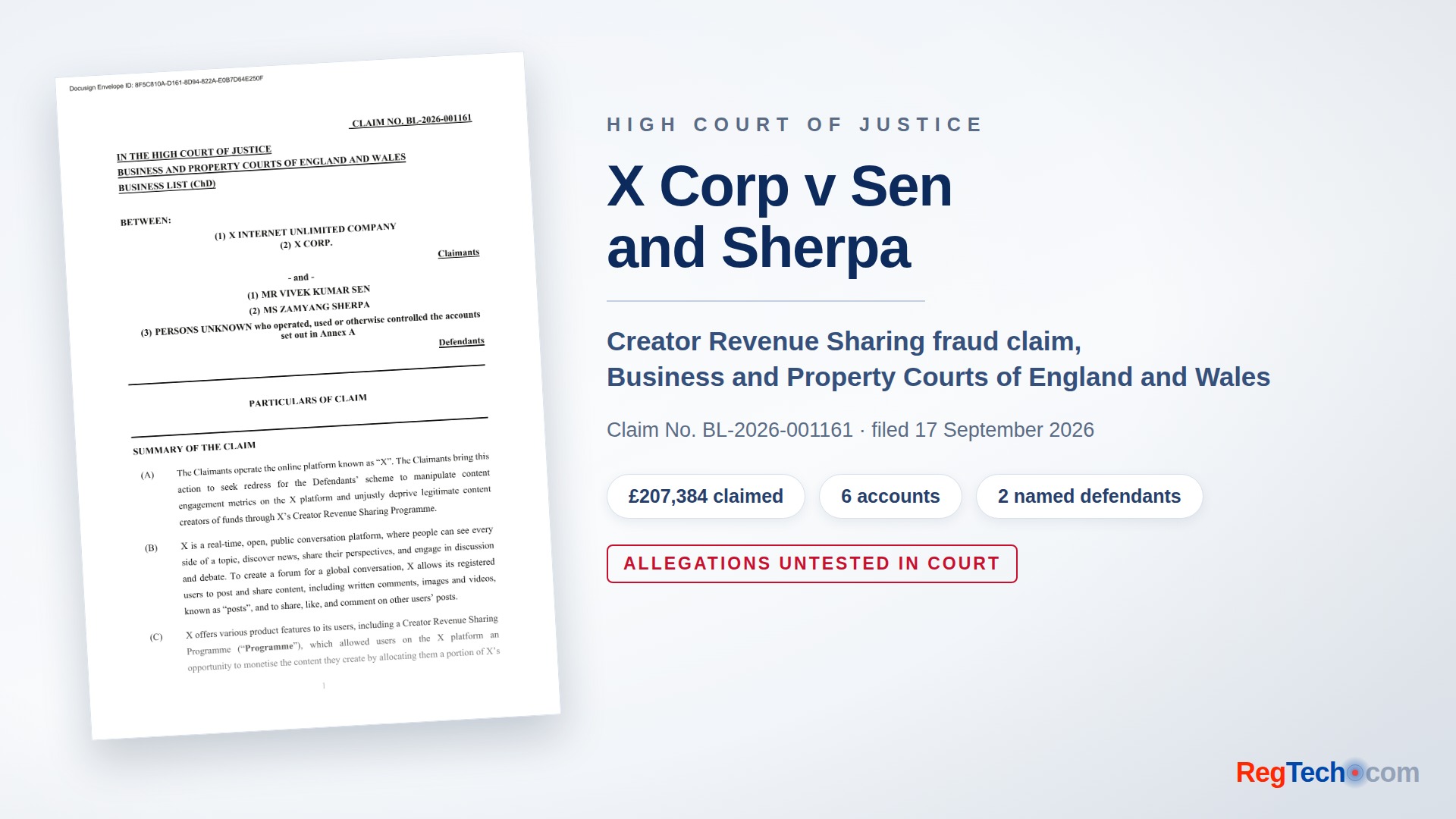
X has brought a case to the High Court in London over what it says was a coordinated network of accounts built to drain its Creator Revenue Sharing Programme. The claim was filed on 17 September 2026 and seeks the return of at least £207,384.
The full Particulars of Claim sit on X's own transparency site, and James Burnham, general counsel of X and xAI, linked the same document from his account on 20 September. Everything below is taken from that filing.
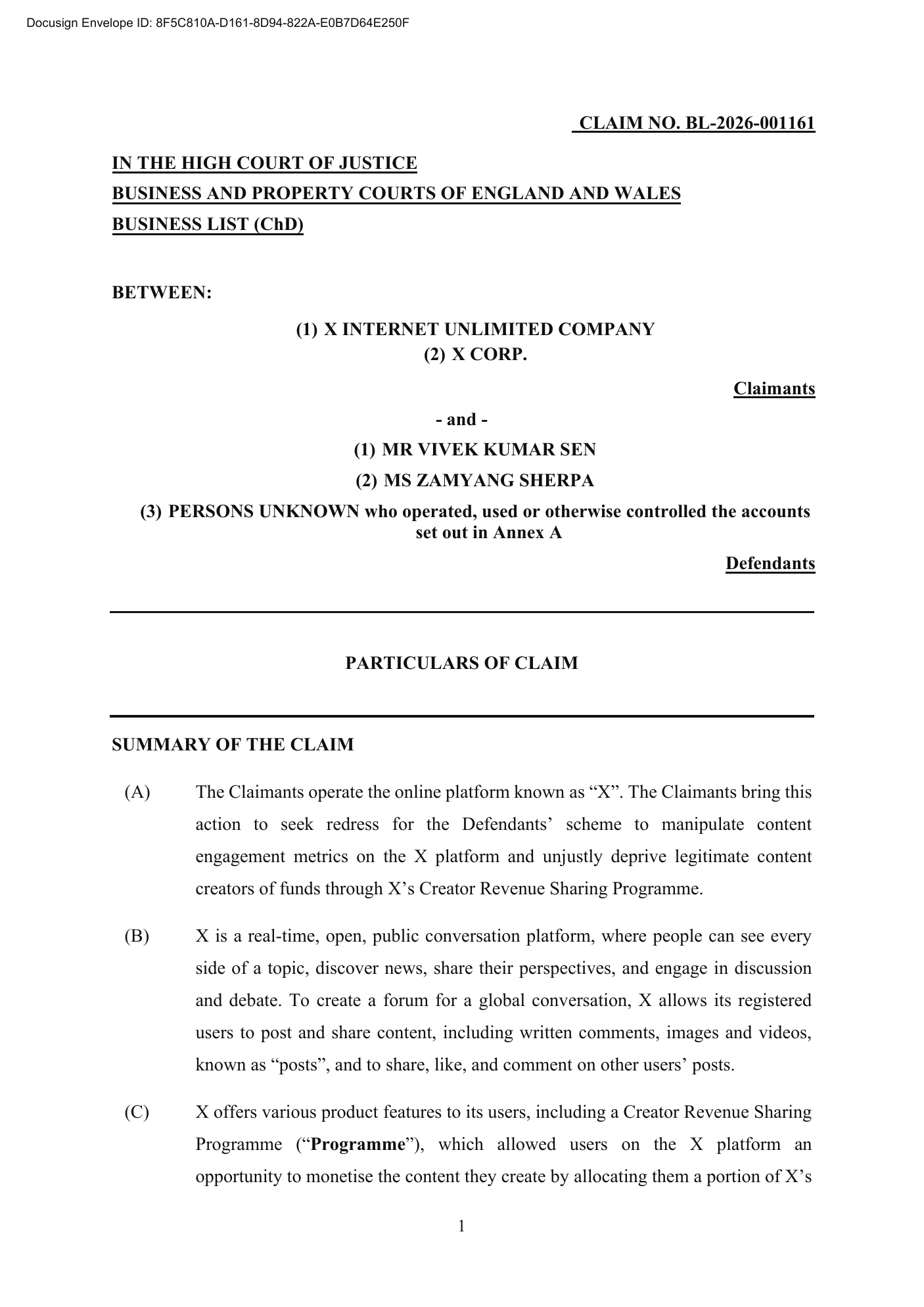
Page one of the Particulars of Claim, claim number BL-2026-001161, as published by X.
The parties
Two claimants are named: X Internet Unlimited Company, the Irish entity, and X Corp. The defendants are named as Mr Vivek Kumar Sen and Ms Zamyang Sherpa, alongside "persons unknown who operated, used or otherwise controlled the accounts set out in Annex A". The case sits in the Business List of the Business and Property Courts of England and Wales. Lewis Silkin LLP acts for X, and the statement of truth is dated 17 September 2026.
What the filing alleges
Six accounts are at the centre of it, enrolled in the programme between 11 August 2023 and 7 February 2026: @Vivek4real_, @Bitcoin_Teddy, @saylordocs, @TrendingBitcoin, @Kalshibacktest and @PolyBackTest. The filing pairs each account with the Stripe payment account it was linked to, which is how X says it connected them to the two named individuals.
The claim breaks the payouts down account by account. Three are attributed to Sen: £74,332.44 through @Vivek4real_, £49,441.91 through @saylordocs, and €58,257.48 through @Bitcoin_Teddy, which the filing equates to roughly £50,065. The three attributed to Sherpa are smaller, at £22,938.35, £6,705.25 and £3,490.71.
The case is that these were not six independent creators but one operation. X pleads that the accounts were operated as a single coordinated network for the purpose of manipulating engagement metrics to generate payouts the defendants were not entitled to, by publishing near-duplicate content, liking and reposting one another to inflate the numbers, and spreading activity across several accounts so that suspending one would leave the rest running.
The timestamps do the heavy lifting. The filing points to two accounts publishing substantively similar content 11 seconds apart, and to a further instance 31 seconds apart. X also alleges the defendants went beyond their own accounts, offering paid engagement manipulation to third parties and seeking to acquire further high-follower accounts.
Annex A, the schedule the "persons unknown" defendants are tied to, lists three further handles, @BTC_Vibes, @MrSuperBitcoin and @Laserlump, which X says repeatedly amplified the monetised accounts. Suing persons unknown alongside named individuals is a standard device in English civil procedure where a claimant can identify accounts but not yet everyone behind them, and it leaves room to add defendants as disclosure progresses.
Paragraph 26 is one sentence: "On 18 August 2026, X suspended the Defendants' accounts for coordinated revenue sharing fraud and platform manipulation."
What X is asking for
The Particulars of Loss carry two figures. Payments made under the programme are put at "not less than £207,384". The cost of investigating, analysing and remediating is "not presently known, but expected to be a figure of not less than £75,000".
The causes of action pleaded are deceit, unlawful means conspiracy, breach of contract, knowing receipt and unjust enrichment, with a constructive trust argued over the funds. X asks for delivery up of the payments, damages, equitable and restitutionary compensation, interest under section 35A of the Senior Courts Act 1981, and costs.
"Last week, @X sued several people who abused Creator Revenue Sharing by operating a coordinated network of accounts, posting inauthentic content to manipulate engagement, and using multiple bank accounts to hide their scheme," by James Burnham of X
Nothing here is proven
Neither named defendant has responded publicly, and the accounts in the claim are suspended, so they have no platform on which to do so. A defence would not be due yet. Every allegation above is X's own, pleaded and untested.
Why it matters beyond one platform
Creator monetisation has quietly turned into a payments business. A programme that pays on engagement is, in control terms, a disbursement channel with an automated approval rule, where the thing being approved is a number the recipient can influence. That shape is familiar to anyone who has worked through money mule typologies: many thin accounts, layered payment identities, and value moving faster than manual review can follow.
The network pattern is familiar too. Platform action against coordinated inauthentic account estates normally stops at suspension. What is different here is that X has followed the suspension with a civil money claim in a London court, naming individuals and the payment accounts behind them.
Jurisdictions writing platform duties into law, as Singapore has with its Scams Bill, are working on the public version of the same question: who is responsible for spotting a coordinated network, and what happens to the money once it has already been paid out.
If the claim succeeds, the more useful precedent may not be the £207,384. It may be the demonstration that a platform can reconstruct a payout fraud from its own telemetry, to the standard a court expects, and attach a claim number to it.