From Fragmentation to Fungibility: Can ASEAN Build the World’s First Interoperable Carbon Region?
A Diamond Jubilee moment
When Singapore assumes the ASEAN Chairmanship in 2027, it will do so at an extraordinary inflection point. ASEAN will mark its 60th anniversary while the Paris Agreement moves from commitments towards implementation, financing and measurable outcomes.
These should not be regarded as unrelated milestones. At 60, ASEAN has an opportunity not simply to commemorate what regional cooperation has achieved, but to define what regional cooperation should accomplish in its next generation.
The economics are compelling. ASEAN’s Strategy for Carbon Neutrality estimates that the transition could create US$3 trillion to US$5.3 trillion of additional GDP value by 2050, attract US$3.7 trillion to US$6.7 trillion of green investment and support 49 million to 66 million additional jobs.[1] Yet the International Energy Agency reports that Southeast Asia attracted just over US$100 billion of energy investment in 2025, only around 3 per cent of the global total despite representing 5 per cent of global energy demand and 9 per cent of the world’s population.[2]
The strategic question is therefore not simply whether ASEAN should decarbonise. It is whether ASEAN can build the market architecture that converts decarbonisation into economic value.
Why Article 6 matters
For those outside carbon markets, Article 6 of the Paris Agreement can appear technical. Its strategic purpose is simpler. The cost and availability of reducing emissions differ greatly between countries. One economy may possess forests, renewable resources or methane abatement opportunities. Another may have fewer domestic mitigation options but substantial capital and demand for credible mitigation outcomes.
Article 6 creates mechanisms through which countries can cooperate. Article 6.2 provides accounting and reporting guidance for internationally transferred mitigation outcomes. Article 6.4 establishes a UN mechanism for high quality carbon credits. Article 6.8 provides for voluntary non market cooperation that does not involve transfers of mitigation outcomes.[3]
Where an authorised mitigation outcome is transferred internationally, corresponding adjustments are central to avoiding double counting. Singapore’s agreement with Viet Nam, for example, explicitly describes a legally binding framework for correspondingly adjusted high integrity carbon credits.[4]
Unlike oil, copper or electricity, a carbon credit derives its value from an emission that was avoided or reduced, or carbon that was removed. Its credibility therefore depends upon evidence, measurement, verification, ownership and accounting.
“In carbon markets, trust is not ancillary to the asset. Trust creates the asset.”
A market moving into the economic mainstream
The World Bank reports that 87 direct carbon pricing policies now cover just over 29 per cent of global greenhouse gas emissions and mobilised more than US$107 billion for public budgets in 2025.[5]
ASEAN already has evidence of international demand. In July 2026, the ASEAN Secretariat reported that member states supplied 7 per cent of the then current global supply of CORSIA Eligible Emission Units, comprising 2.6 million units from four projects in Cambodia and Lao PDR. A study by Boeing, GenZero and Abatable cited by ASEAN estimated that supplying eligible credits to international aviation could represent an opportunity of up to US$8.5 billion for ASEAN countries over the following decade.[6]
But carbon trading itself is not the largest prize. The greater opportunity is whether trusted carbon revenues can help mobilise investment into forests, peatlands, mangroves, methane reduction, waste recovery, renewable energy, bioenergy, sustainable fuels and industrial decarbonisation.
These activities do not automatically create carbon credits. They must produce additional, measurable and verifiable mitigation under eligible methodologies and applicable national and international rules.
“The strategic value of carbon markets is not the creation of another commodity. It is their potential to convert measurable decarbonisation into financeable economic value.”
From national strengths to an ASEAN carbon value chain
ASEAN’s diversity can become an economic strength rather than a regulatory weakness.
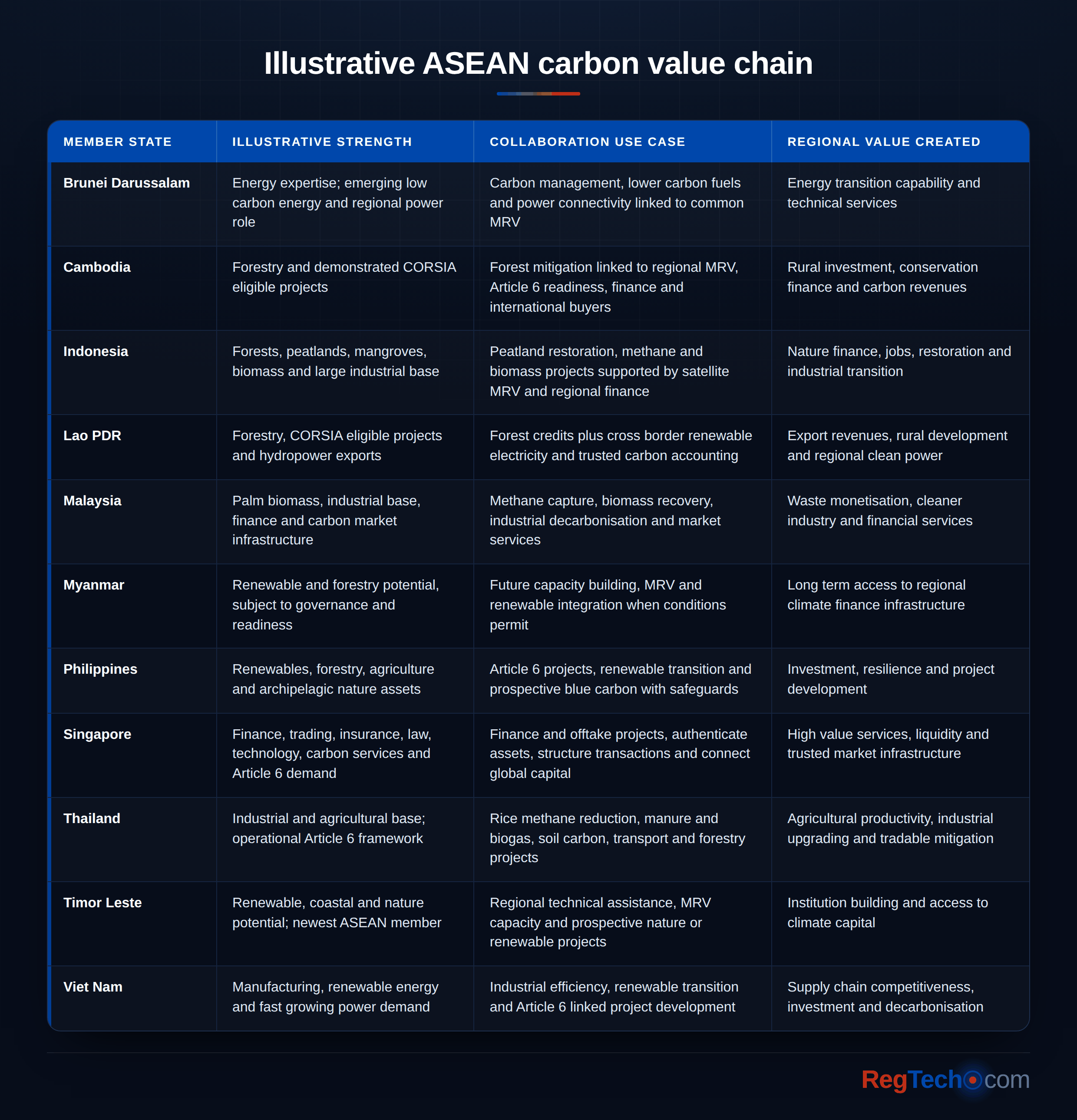
Indonesia brings globally significant forests, peatlands, mangroves, agricultural value chains and bioenergy capability. FAO reports that Riau alone contains almost five million hectares of carbon rich peatland and is strengthening MRV systems for REDD+ readiness.[7] ASEAN Centre for Energy identifies Indonesia as the regional leader in commercialised biomass cofiring capacity.[8]
Malaysia brings complementary capabilities in palm biomass, bioenergy, industry and financial markets. In both Indonesia and Malaysia, the credible opportunity is not the plantation itself, but measurable interventions such as methane capture, waste recovery, biomass utilisation and other eligible mitigation activities.
Cambodia and Lao PDR demonstrate how smaller economies can participate in international carbon markets. Their projects already account for the 2.6 million CORSIA eligible units reported by ASEAN.[6] Lao PDR also contributes hydropower and regional electricity connectivity.
Viet Nam combines a rapidly industrialising economy with renewable energy growth and supply chain decarbonisation opportunities. Thailand brings a substantial industrial and agricultural base and increasingly operational carbon market infrastructure. The Singapore Thailand Article 6 eligibility list already includes methodologies covering rice water management, animal manure and biogas, soil organic carbon, transport, afforestation and REDD+.[9]
The Philippines combines renewable energy and nature based opportunities, and signed its first Article 6 Implementation Agreement with Singapore in April 2026.[10] Brunei Darussalam contributes energy expertise and a potential role in lower carbon fuels, carbon management and regional power trade. Timor Leste, ASEAN’s newest member, can progressively participate as its renewable energy, nature and climate finance capabilities develop. Myanmar also possesses significant renewable and forestry potential, although participation will depend on domestic conditions and institutional readiness.
Singapore contributes something different: finance, commodity trading, insurance, law, technology, professional services, regulatory capability and international market connectivity.
This creates a regional value chain rather than a contest over who owns the credit. A forest project can create local livelihoods and environmental value in Indonesia. Regional technology firms can provide satellite monitoring and digital MRV. Verification creates work for auditors and specialists. Financial institutions can structure capital. Insurers can underwrite risks. Registries and trading platforms can facilitate transactions. Governments retain sovereignty over authorisation while participating businesses gain access to credible mitigation outcomes.
“The forest may be in Indonesia, the renewable electricity generated in Lao PDR, the methane reduction achieved in Malaysia, the technology developed elsewhere in ASEAN, and the financing structured in Singapore. A trusted market allows value to travel while sovereignty remains at home.”
Eleven economies, one regional carbon value chain
The strongest case for an ASEAN carbon architecture is not theoretical harmonisation. It is the ability to connect real projects, capabilities and demand across all eleven member states. The region does not need every country to perform the same function. It needs a system in which different strengths become complementary parts of a trusted value chain.
Consider an illustrative forest and peatland corridor. Indonesia can originate high integrity restoration and avoided degradation activities, supported by field science, satellite observation and digital MRV. Cambodia and Lao PDR already demonstrate that smaller economies can generate internationally eligible units: ASEAN reported 2.6 million CORSIA Eligible Emission Units from four projects in the two countries in 2026.[6] Singapore can contribute project finance, insurance, legal structuring, carbon services and international demand. Under an Article 6 framework, host governments retain authority over project approval and corresponding adjustments while revenues and technical capabilities remain anchored in the originating economies.
A second use case sits in agriculture and waste. Malaysia and Indonesia possess major palm oil and biomass value chains. The carbon opportunity is not the plantation itself, but verified interventions such as methane capture from palm oil mill effluent, biomass utilisation, waste conversion and eligible restoration. Thailand provides a practical bridge from concept to implementation: its operational Article 6 framework with Singapore already recognises methodologies involving rice water management, manure and biogas, soil organic carbon, transport, afforestation and REDD+.[9] The same regional architecture could allow technology, verification, finance and offtake expertise developed in one ASEAN economy to support projects in another.
A third use case is industrial decarbonisation. Viet Nam, Thailand, Malaysia, Indonesia and the Philippines contain large manufacturing and export supply chains. As multinational customers face increasingly demanding climate requirements, credible mitigation data can become part of industrial competitiveness. An ASEAN manufacturer that can demonstrate authenticated reductions through recognised MRV and carbon accounting could be better positioned to participate in lower carbon regional supply chains. Carbon markets would then operate alongside energy efficiency, renewable procurement and transition finance rather than as a substitute for them.
A fourth use case links carbon markets with electricity integration. Lao PDR has an established role in hydropower exports. Viet Nam has rapidly expanded renewable generation. Thailand and Malaysia occupy important positions in mainland and peninsular power connectivity, while Singapore provides concentrated electricity demand and sophisticated capital markets. Brunei Darussalam can contribute energy system expertise and participate in emerging lower carbon fuel, carbon management and regional power initiatives. The ASEAN Power Grid can connect physical electricity flows, while common carbon accounting can help ensure that renewable attributes and emission claims are not counted twice.
A fifth use case is the blue and nature economy. The Philippines and Indonesia possess extensive archipelagic ecosystems, while Malaysia, Brunei Darussalam, Cambodia, Viet Nam and Timor Leste also have coastal and marine assets. Where scientifically robust methodologies and national rules permit, mangrove restoration, coastal ecosystem protection and other nature based activities could create combinations of climate, biodiversity and community value. Timor Leste, as ASEAN's newest member, could use regional technical assistance, MRV infrastructure and climate finance capabilities to build institutional readiness rather than having to recreate the entire carbon market stack independently.
Myanmar should be approached differently. Its renewable energy and forestry resources indicate long term mitigation potential, and ASEAN energy research has modelled substantial renewable integration opportunities involving Myanmar, Cambodia and Lao PDR. However, any near term carbon market participation must depend upon domestic conditions, governance, credible safeguards and institutional readiness. Inclusion in a regional architecture should therefore mean access to future capacity building and common infrastructure, not the presumption of immediate project eligibility.
These examples reveal the economic logic of a carbon superstructure. Indonesia, Cambodia and Lao PDR can contribute nature based mitigation. Malaysia, Indonesia and Thailand can contribute agricultural, biomass and methane reduction opportunities. Viet Nam, Thailand, Malaysia, Indonesia and the Philippines can drive industrial transition. Lao PDR, Viet Nam, Thailand, Malaysia, Brunei Darussalam and Singapore can contribute to increasingly connected energy systems. Singapore can add finance, trading, insurance, law, technology and international market connectivity. Timor Leste can gain access to regional capability as a new member, while Myanmar can participate progressively as conditions allow.
“The ASEAN advantage is not that eleven economies possess the same carbon assets. It is that eleven different economies can contribute different pieces of the same climate value chain.”
Building the carbon superstructure
ASEAN therefore needs more than another exchange. It could progressively develop an ASEAN Carbon Interoperability Architecture, a common superstructure connecting national systems while allowing each member state to retain its own policies, assets and development priorities.
The principle should be interoperability without uniformity.
First, participating jurisdictions could establish minimum principles for recognising credible methodologies, standards and verification.
Second, Article 6 cooperation could become progressively more interoperable. Singapore has now signed Implementation Agreements with four ASEAN partners: Thailand, Viet Nam, the Philippines and Lao PDR. The Lao PDR agreement, signed in September 2026, was Singapore’s 12th Article 6 Implementation Agreement overall.[11] These bilateral frameworks could become practical laboratories for compatible approaches to authorisation, corresponding adjustments, reporting, transfer and retirement.
Third, ASEAN can strengthen digital MRV and authentication through satellite observation, IoT sensors, artificial intelligence and auditable digital systems. The UN architecture itself is developing registry infrastructure for recording and tracking Article 6 transactions.[3]
Fourth, ASEAN could explore an ASEAN Carbon Passport. This would not replace national registries or international standards. It would provide a common digital information protocol covering project identity, country of origin, methodology, vintage, MRV evidence, verification, registry identification, Article 6 authorisation, corresponding adjustment status, ownership and retirement.
“Interoperability without integrity simply allows poor quality carbon to travel faster.”
Carbon markets as economic integration
There is a useful parallel with international trade and finance. Markets become larger when every transaction does not require trust to be rebuilt from the beginning. Common documentation, interoperable standards and trusted settlement infrastructure reduce friction while allowing different sovereign systems to coexist.
ASEAN is already applying this logic elsewhere. Its Regional Investment Promotion Action Plan 2025 to 2030 explicitly promotes integrated regional value chains in which member states participate according to complementary economic strengths.[12]
The ASEAN Power Grid provides another parallel. ASEAN estimates that US$764 billion of generation and transmission investment is required for the regional grid vision.[13] Research hosted by the ASEAN Centre for Energy finds that cross border electricity trading can be economically advantageous on a pathway towards net zero, including connections involving Brunei and East Malaysia, Lao PDR, Viet Nam and Cambodia, and Thailand, Peninsular Malaysia and Singapore.[14]
The Power Grid can move electrons. A trusted carbon architecture can move verified environmental value. Finance can connect both.
“ASEAN should not build a carbon market in which countries compete to sell the same commodity. It should build a carbon value chain in which countries monetise different comparative advantages.”
Why 2027 should be the starting point
There are anniversaries that commemorate history, and anniversaries that provide permission to shape the future. ASEAN’s 60th anniversary should be the latter.
Singapore’s Ministry of Foreign Affairs has explicitly described the coincidence of the 2027 Chairmanship and ASEAN’s Diamond Jubilee as an opportunity to deepen regional integration, keep ASEAN open for business and strengthen its relevance globally. Singapore has also identified the ASEAN Power Grid and green economy standards among areas for deeper integration.[15]
The objective for 2027 should not be to announce a completed ASEAN carbon market. Building interoperability requires years of technical work, consultation and confidence building.
The more credible ambition is to commence the architecture.
Singapore could use 2027 to convene governments, regulators, carbon market institutions, financial institutions, technology providers and industry; agree principles; establish technical working groups; and initiate pilot corridors among willing member states.
This would make the Diamond Jubilee more than a celebration of ASEAN’s first 60 years. It would create an institution building project for its next generation.
“The opportunity of ASEAN at 60 is to convert national comparative advantage into regional collective advantage.”
From comparative advantage to collective advantage
For countries rich in forests and natural capital, trusted markets can create additional value from credible conservation and restoration. For agricultural economies, methane reduction, biomass and waste recovery can create new revenue and technology opportunities. For renewable energy economies, connectivity can expand markets for cleaner electricity. For industrial ASEAN, carbon pricing and credible markets can encourage efficiency and technological upgrading. For developing member states, climate finance can bring capital, capacity and new sources of income. For Singapore, the opportunity is to deepen a high value services cluster spanning finance, trading, insurance, law, technology, verification and sustainability advisory.
The win is not that every ASEAN country becomes the same kind of carbon economy. The win is precisely that they do not need to.
Sixty years ago, ASEAN’s founders built an architecture that allowed very different countries to cooperate without surrendering sovereignty. In its 60th year, ASEAN has an opportunity to begin constructing another architecture, this time connecting sustainability, technology and capital.
Article 6 provides the international framework. ASEAN possesses the opportunities. Digital technology can strengthen authentication. Singapore can contribute financial and trust infrastructure. What remains is connectivity.
The ultimate promise of an ASEAN carbon market is therefore not the price of a tonne of carbon.
It is the economic value that a trusted tonne of carbon can catalyse across an entire region.
Dr Victor Tay the Chairman of UN Global Compact and is Group CEO of Global Catalyst Advisory.
Verification note
Statistics and institutional claims in this draft were checked against the cited primary or institutional sources on 26 September 2026. The ASEAN Carbon Interoperability Architecture and ASEAN Carbon Passport are policy proposals advanced in this article, not existing ASEAN programmes. Country examples are framed as potential or demonstrated areas of participation and should not be read as asserting that the underlying natural resource or industrial activity automatically qualifies for carbon credits.