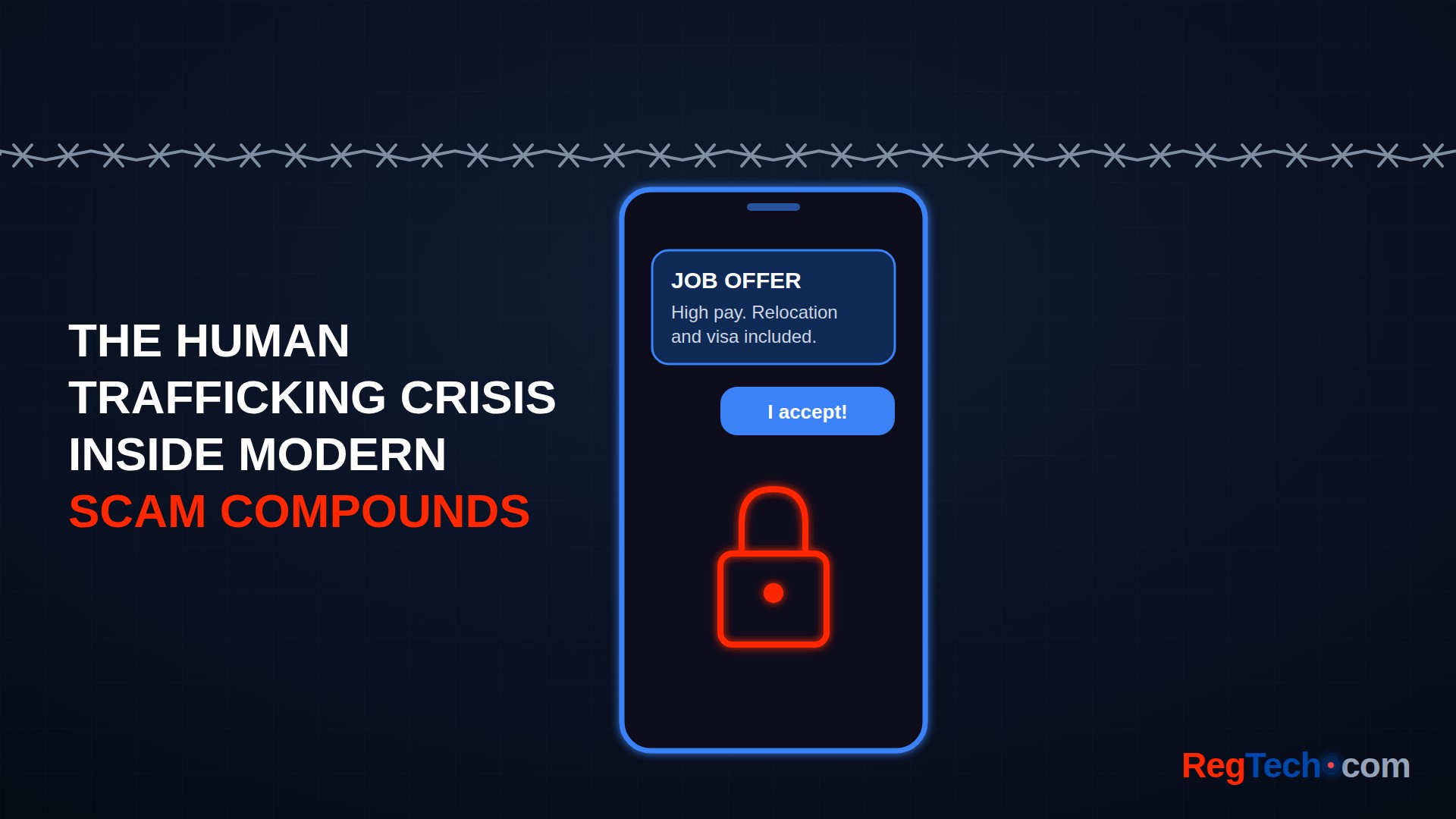
The operational pipeline behind industrialised scam compounds follows a calculated sequence: targeted recruitment, deceptive cross-border relocation, document confiscation, and forced cyber-enabled fraud.
The architecture produces a dual-ended victim model:
At the origin, a trafficked individual operating under coercion.
At the terminal end, an investor or consumer targeted through social engineering.
Between them lies the global payments perimeter.
The proceeds do not move through a single channel; they exploit systemic friction across shell entities, correspondent banking rails, digital payment gateways, peer-to-peer crypto rails, and high-turnover merchant accounts.
For RegTech and compliance functions, modern transaction monitoring can no longer treat fraud and anti-money laundering (AML) as siloed operational risks. When fraudulent inflows intersect with the financial trails of human trafficking, transaction metadata ceases to be purely financial. It becomes an evidentiary record of human exploitation.
A CRIMINAL BUSINESS MODEL BUILT ON HUMAN LIVES
The Asia/Pacific Group on Money Laundering’s Cyber Scam Hubs and Human Trafficking Report 2026 describes cyber scam hubs as sophisticated transnational criminal enterprises combining large-scale online fraud with human trafficking and exploitation. The report draws on case studies, law-enforcement experience, regional analysis, and blockchain insights to explain how these compounds operate and how their financial and technological enablers allow them to grow.
The report identifies several enabling conditions, including weaknesses associated with special economic zones, complex corporate structures that conceal ownership, and the use of virtual currencies. It calls for monitoring, intelligence sharing, international cooperation, and strong anti-money-laundering and counter-financing controls.
Chainalysis offers another warning. Its 2026 analysis found that cryptocurrency flows to identified services suspected of involvement in human trafficking grew by 85 percent in 2025, reaching hundreds of millions of dollars. Chainalysis connects this growth with an illicit ecosystem involving Southeast Asian scam compounds, online gambling operations, and money-laundering networks operating largely through Telegram.
The numbers matter.
But people matter more.
Behind every suspicious transfer may be someone recruited through deception, controlled through fear, and forced to generate profits for someone else.
CRYPTO DID NOT CREATE HUMAN TRAFFICKING
This needs to be said plainly: cryptocurrency did not invent trafficking, exploitation, or money laundering.
Traffickers have long used cash, banks, money-transfer businesses, commercial transactions, and legitimate financial services to move and conceal proceeds. The U.S. Department of State has noted that a significant portion of trafficking profits passes through legitimate financial-service businesses. These financial activities can include payments for transport and logistics, the collection and movement of proceeds, and corrupt payments that facilitate trafficking.
We should therefore resist two equally misleading conclusions.
1 | The first is that crypto is uniquely responsible for trafficking.
2 | The second is that crypto is merely neutral technology and its builders, platforms, and users bear no responsibility for how it is used.
Both positions are too easy.
The honest position is more demanding. Criminals exploit whatever financial rails offer reach, liquidity, speed, concealment, or weak oversight. Fiat remains integral to the trafficking economy, while cryptocurrency offers new ways to move value across jurisdictions and connect participants without relying on traditional intermediaries. The policies and laws dictating the risk-reward proportion for both payment pathways must be addressed.
Yet cryptocurrency also provides an advantage cash does not: transactions recorded on a public blockchain can create a lasting financial trail. Chainalysis argues that this transparency gives law enforcement and compliance teams opportunities to detect, trace, and disrupt trafficking operations.
In other words, traffickers can exploit blockchain.
It can also help expose them.
The technology does not make that choice.
We do.
DECENTRALIZATION DOES NOT DECENTRALIZE RESPONSIBILITY
DeFi was built around compelling ideas:
- Broader access
- Reduced dependence on intermediaries
- User control
- Cross-border participation
- Open and programmable financial systems
Those possibilities deserve serious exploration.
But freedom without attentiveness can become cover for exploitation. And decentralisation must never become an excuse to decentralise responsibility.
So here is the question I would ask every founder, investor, exchange, protocol developer, compliance professional, validator, and everyday user:
If we participate in a financial system designed to expand human freedom, what responsibility do we bear when that same system is used to take freedom away from someone else?
A person does not have to be a trafficker to contribute to an environment traffickers can exploit.
Sometimes all exploitation requires is a system in which no one is paying attention.
Responsible participation therefore means more than avoiding an obviously suspicious transaction. It means building systems that recognise risk, sharing intelligence, supporting appropriate safeguards, strengthening identity and due-diligence practices at critical entry and exit points, and reporting patterns that may indicate coercion or organised exploitation.
It also means remembering that compliance is not merely a regulatory burden.
Done well, it is a form of protection.
FOLLOWING THE MONEY TOWARD FREEDOM
Financial information can reveal relationships that criminal networks work hard to conceal.
The APG report calls for earlier identification, stronger prevention, better international cooperation, improved asset recovery, and stronger support for victims. Chainalysis identifies monitoring opportunities such as repeated payments to recruitment services, high-volume activity through guarantee platforms, concentrated transfers to high-risk locations, and wallet activity connected to multiple categories of illicit services.
But financial intelligence must connect with human intelligence and survivor-centred action.
Organisations like Hope for Justice work to identify victims, support survivors, and prevent exploitation. Their investigators and outreach teams work with police and other agencies, while their survivor services, professional training, and prevention programs work with governments and businesses to address trafficking from several directions.
This matters because tracing money is not the final goal.
Human freedom and flourishing are.
Social Enterprises like Slave-Free Alliance work with companies to address modern-slavery and labour-exploitation risks in their operations and supply chains. Its services include training, gap analysis, site assessment, technical support, and longer-term programs designed to strengthen organisational responses to exploitation.
This supply-chain work is financially relevant. Exploitation survives because it can be profitable. It hides inside procurement decisions, subcontracting arrangements, labour recruitment, weak corporate controls, and opaque business relationships.
When companies improve visibility, assess risk, train employees, engage suppliers, respond effectively to warning signs, and provide meaningful remediation, they make it harder for traffickers and exploitative labour brokers to turn human vulnerability into revenue.
That affects the movement of both fiat and crypto, because it disrupts the commercial relationships and profit incentives sitting beneath the transactions.
ENSURING FREEDOM IS ON EACH OF US IN THE DECENTRALIZED FUTURE
The future of commerce and community will likely be increasingly decentralised, automated, borderless, and network-oriented.
Value will move through combinations of fiat currency, stablecoins, tokenised assets, digital identities, smart contracts, and financial tools that have yet to be created. Communities may organise economic activity without sharing a physical location, a traditional bank, or even a common national jurisdiction.
This could unlock remarkable human possibility, especially empowering communities and countries where hyperinflation has been crippling and access to the global economy is limited.
A farmer, entrepreneur, caregiver, artist, donor, or displaced person may be able to participate in global commerce with fewer barriers. Communities could fund shared needs, coordinate resources, and direct capital toward life-giving purposes with unprecedented speed.
But the same infrastructure could also let criminals recruit, transact, coordinate, and move proceeds at greater scale.
That is why thoughtful regulation AND user responsibility are critical.
Regulation should not suffocate responsible innovation. It should set defensible boundaries, strengthen accountability where digital and fiat systems meet, enable legitimate investigation, protect consumers, and make it harder to profit from another person’s exploitation.
Regulators cannot carry that responsibility alone.
Rules are always chasing innovation. Technology moves quickly, criminal networks adapt, and no regulatory system can observe every wallet, transaction, platform, or online community.
That is why user attentiveness matters as much as regulation.
We must build a culture in which people ask better questions:
- Who benefits from this transaction?
- Who might be harmed?
- What has this platform done to identify coercion and exploitation?
- Are suspicious patterns being reported or merely processed?
- Does the system reward us for looking away?
- When freedom and friction come into tension, whose freedom are we protecting?
The future of finance will not be made ethical by code alone.
The character of the communities using the code will shape it.
IT IS A FUTURE WORTH BUILDING
Commerce has always been more than moving money.
Commerce reveals what we value, whom we trust, what we reward, and what we are willing to overlook.
In a decentralised future, community may become one of our most important forms of accountability. Regulation can set the floor. Technology can create visibility. Investigators can follow financial trails. Companies can protect their supply chains. Nonprofits can identify victims and support survivors.
But ordinary participants must remain alert.
The next generation of financial systems should not be judged only by transaction speed, market capitalisation, accessibility, or return on investment.
It should also be judged by a more human measure:
How does this new financial system ensure freedom while exposing exploitation?
If decentralised finance is truly about personal freedom, then fighting human trafficking cannot remain someone else’s responsibility.
It belongs to all of us.
Together, we can build a future of commerce and community that is innovative, prosperous, open, and life-giving.
Together, there is hope for justice.