When Belief Becomes a Market: Prediction Markets, Inside Information and the Gamification of Risk
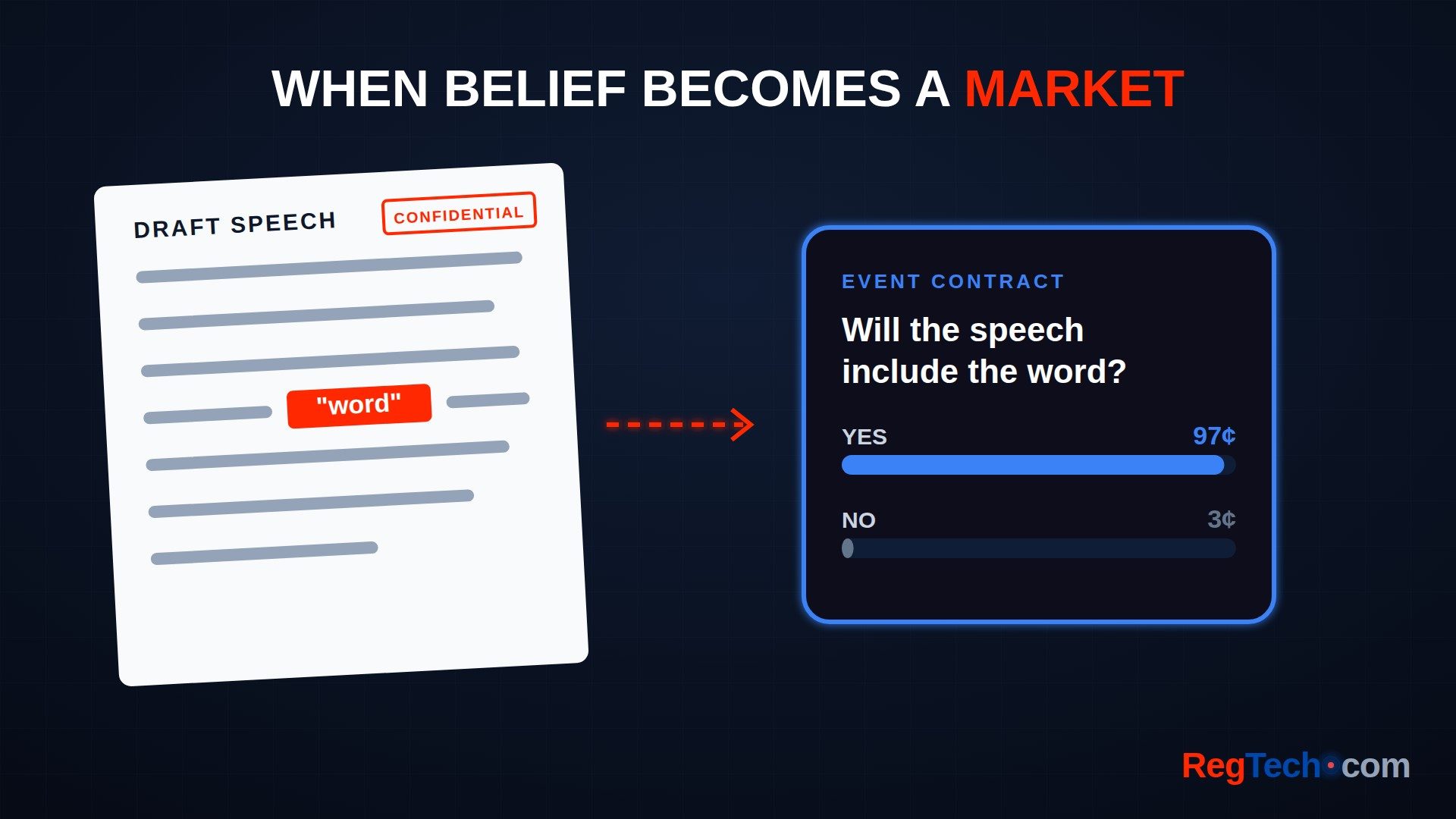
Perhaps the clearest sign that prediction markets have become real markets is that they now have insider-trading scandals.
On 28 August, the US Commodity Futures Trading Commission ordered Gabriel Perez, a former White House teleprompter operator, to surrender US$107,539 in profits and pay a US$65,000 penalty. Perez had advance access to presidential speeches and used that information to trade contracts on whether particular words or phrases would appear in them. The CFTC found that he had misappropriated material non-public information obtained through his government employment, in breach of a duty of trust and confidence.
For most participants, whether the president would utter a particular word was a prediction. For someone who had already read the speech, it was something rather different.
The case exposes a tension at the heart of prediction markets. Their intellectual appeal rests on rewarding people who know more than everybody else. Yet functioning markets also depend on deciding which informational advantages participants should be allowed to monetise.
That tension will become harder to ignore as prediction markets move from niche forecasting experiments towards mainstream retail products.
Why markets need people who know more
The economic case for prediction markets is serious.
Most public forecasting is remarkably undisciplined. Commentators predict elections, recessions or interest-rate decisions and suffer few consequences when they are wrong. Prediction markets impose a different discipline. Instead of saying that an event is “likely”, a participant must decide what probability to attach to it and whether the market price is sufficiently wrong to justify putting money behind that belief.
This is one manifestation of a much older insight about markets and information. In their celebrated 1980 paper, Sanford Grossman and Joseph Stiglitz demonstrated the paradox at the heart of informational efficiency: if prices already incorporated all available information perfectly, nobody would have an incentive to incur the cost of acquiring information in the first place. Markets therefore need some reward for becoming better informed.
Prediction markets make that mechanism unusually visible. One participant has better polling data. Another has built a better model. Another has noticed a piece of information the crowd has neglected. They trade, and their information becomes reflected, however imperfectly, in the price.
The same mechanism can have practical uses beyond forecasting. Businesses are beginning to experiment with event contracts as hedges against specific risks for which conventional derivatives or insurance may be unavailable or uneconomic. Recent US examples have included contracts designed around regulatory changes, weather and other event-driven exposures.
But rewarding information creates an obvious question: what sort of information?
The insider’s paradox
Consider three traders.
One has studied every available poll and speech. Another has built a statistical model materially better than everybody else’s. A third has secretly obtained tomorrow’s poll results.
All three possess an informational advantage. Yet most legal systems instinctively distinguish among them.
The distinction is more precise than a general prohibition on trading when one knows more than the market.
American insider-trading law has never imposed a general parity-of-information requirement. In United States v O’Hagan, the US Supreme Court upheld the misappropriation theory: liability arose because confidential information was taken for trading in breach of a duty owed to its source. Writing for the Court, Justice Ruth Bader Ginsburg recognised that informational disparities are inevitable in markets. The legal problem was not superior knowledge by itself, but the deceptive appropriation of information entrusted in confidence.
The CFTC has adopted substantially the same distinction for commodity derivatives. Rule 180.1, modelled on SEC Rule 10b-5, reaches trading on material non-public information where that information has been misappropriated in breach of a pre-existing duty of trust or confidence. Yet the CFTC has expressly rejected a parity-of-information regime. Its enforcement director put the point unusually plainly this year: market participants may trade on material non-public information they “rightfully own”.
That qualification sharpens the prediction-market paradox.
Prediction markets need information asymmetry. Otherwise there would be little reason for informed participants to trade against uninformed ones. The regulatory objective therefore cannot be to eliminate informational advantage.
It is to distinguish information acquired through analysis, observation or legitimate economic activity from information obtained or used in violation of duties, market rules or the integrity of the event itself.
The Perez case is no longer isolated. The CFTC has highlighted two earlier cases investigated by Kalshi. In one, a political candidate traded contracts on his own candidacy, despite having direct influence over the outcome. In another, an editor for a popular YouTube channel apparently traded successfully on forthcoming video content to which his employment gave him advance access. Kalshi imposed disgorgement, financial penalties and suspensions in both cases.
These are different fact patterns. One involves privileged information; another approaches the more troubling situation where a trader can influence the event on which the market is settling.
A market needs informed traders. It does not follow that every informational advantage, or every means of obtaining one, should be lawfully tradable.
A price is not a probability oracle
This matters because prediction-market prices are increasingly reported as though they were objective probabilities.
A contract trading at 68 cents can usefully be interpreted as a market-implied probability of roughly 68%. But it does not mean that some omniscient mechanism has determined that the event has precisely a 68% chance of occurring.
The price reflects the information and beliefs of the participants who happen to be trading, filtered through liquidity, market depth, transaction costs, position limits, incentives and market design.
Markets aggregate biases as well as information. The hope is that informed capital arbitrages enough of those biases away.
Behavioural finance gives us reasons for caution. Overconfidence can encourage traders to exaggerate the superiority of their own information. Probability weighting can make long-shot outcomes disproportionately attractive. Confirmation bias can turn a trade into an expression of an existing political or social belief.
Liquidity introduces another problem. A price generated by a deep market containing sophisticated participants deserves different evidential weight from the same price generated by a handful of trades in a thin order book.
A market can therefore be transparent about its price without being equally transparent about the quality of the information embedded in that price.
For platforms displaying an implied probability prominently to retail customers, market depth should not be relegated to an obscure secondary screen. If users are encouraged to consume a price as information, they should also be able to see how much market activity stands behind it.
When forecasting becomes entertainment
There is then a second tension.
Prediction markets may have intellectual origins in information aggregation, but their retail incarnation increasingly resembles the wider world of consumer trading, sport and entertainment.
A modern event contract is exceptionally intuitive. Choose “Yes” or “No”. Pay a price. Receive a fixed amount if the event occurs and nothing if it does not.
That simplicity is part of the product’s attraction. It may also be part of its behavioural risk.
Complex questions about politics, inflation, elections or sport become binary choices with immediately legible prices. Many outcomes resolve quickly. Users receive rapid feedback about whether they were right or wrong.
At this point, arguments about whether prediction markets are “investing” or “gambling” can become less useful than examining how the product is actually being used.
The same contract may perform several economic functions. A business purchasing an event contract because an adverse regulatory decision would raise its costs may genuinely be hedging. A professional trader might be exploiting a pricing discrepancy. Another user may be purchasing entertainment. A fourth may simply enjoy the prospect of turning a strongly held opinion into a financial payoff.
The legal label matters. But the behaviour matters too.
Trading has already borrowed from gaming
This concern is not peculiar to prediction markets.
Retail trading platforms have spent years reducing the friction involved in investing. Much of that development has been beneficial. Lower commissions and better interfaces have widened access to financial markets.
But the incentives of a platform and those of its customers need not be identical. A platform may benefit from more engagement or more transactions even where additional trading does little to improve a customer’s financial position.
The UK Financial Conduct Authority has examined precisely this issue. In an experiment involving more than 9,000 consumers, digital engagement practices including push notifications, flashing prices, leaderboards and points linked to prize draws increased trading frequency and, in some circumstances, investment risk. Subsequent FCA research using actual trading-platform data found that users of apps with more such features traded more frequently and had worse investment outcomes, although the FCA appropriately cautioned that the observational evidence does not by itself establish causation. The FCA research also acknowledged that virtually all of the underperformance on the most feature-heavy apps could be attributed to cryptoasset and CFD trading, products that in its sample were offered only on those apps.
Earlier FCA work found associations between trading apps containing more features of concern and behaviours resembling problem gambling. The regulator has consequently warned platforms about features such as celebratory messages, badges, notifications and other mechanisms that may encourage consumers to take actions against their own interests.
The point is not that investing is gambling, or that making financial products engaging is inherently harmful.
The relevant question is what behaviour the engagement architecture is optimising.
An app that rewards regular saving is using behavioural design. So is an app that repeatedly directs attention towards volatile prices and opportunities to transact. Only one of those designs necessarily benefits from persuading the user to do more.
Prediction markets intensify this tension because the underlying events are often intrinsically engaging: elections, sport, celebrity events, policy decisions and current affairs. The user may arrive with a strong emotional view and immediately be offered a mechanism for monetising it.
For a platform, engagement is measurable. For the user, more engagement is not necessarily more welfare.
The short feedback loop
Binary event contracts also have unusually powerful behavioural characteristics.
A low-priced contract can make a remote outcome seem attractively asymmetric. A user who follows a political campaign obsessively can easily confuse familiarity with superior information. A few successful predictions can strengthen confidence in one's forecasting skill.
Most importantly, many contracts resolve quickly.
Long-term investing can take years to reveal whether a decision was sensible. Prediction markets can provide the emotional sequence of decision, anticipation and reward within hours or days.
Win, lose, repeat.
The same short settlement period that makes prediction markets excellent laboratories for testing forecasts may therefore also make them unusually efficient machines for reinforcing trading behaviour.
Each individual loss may be tightly bounded. But bounded loss per contract does not imply bounded behavioural harm when repeated participation is being encouraged.
Casinos have understood that distinction for a very long time. Financial regulation should understand it too.
Different laws, remarkably similar concerns
The difficulty of drawing the regulatory perimeter is already visible internationally.
The United States currently treats many exchange-traded event contracts as derivatives under the Commodity Exchange Act, although litigation continues over the boundary with state gambling regulation. In April, the Third Circuit found, at the preliminary-injunction stage, that Kalshi had a reasonable chance of showing that federal law pre-empted New Jersey’s regulation of its sports-event contracts. The Ninth Circuit took a different approach in August, allowing Nevada’s regulatory action to proceed. In September, the Sixth Circuit also rejected Kalshi’s pre-emption arguments in proceedings involving Ohio and Tennessee. The divergence illustrates the continuing uncertainty surrounding the regulatory treatment of prediction markets in the United States.
Britain has taken a strikingly functional approach. The Gambling Commission regards prediction markets concerning non-financial events such as politics or sport as falling within gambling regulation where they meet the statutory definition. The FCA, meanwhile, says prediction markets referencing financial or certain climate events may fall within its perimeter and that the financial products it has examined resemble binary options. Retail sale of those binary options remains prohibited because of their speculative, gambling-like characteristics and risk of consumer harm.
Britain has also provided an unusually direct demonstration of how “inside information” can be policed outside securities law. In June, two defendants pleaded guilty to cheating under the Gambling Act after using confidential information about the timing of the 2024 General Election to place bets before the election date was announced. The statutory route was gambling law rather than insider-trading law; the market-integrity intuition was remarkably similar.
The European Union is taking a similarly cautious view. In July, ESMA reminded firms that event contracts may fall within existing binary-option product-intervention measures. Whether a particular prediction contract is a financial instrument depends on what it references, while the same product may also fall within national gambling legislation.
Singapore presents an especially interesting classification problem. The Gambling Control Act defines betting broadly enough to include staking value on the outcome of an event, the likelihood that something will happen, or whether something is true. It even expressly defines a “betting exchange”. Yet the Act excludes business contracts whose making or performance constitutes specified investment activity. Separately, the Securities and Futures Act defines derivatives contracts broadly.
There is no obvious basis today for assuming that a US-style retail prediction-market product would receive one predetermined Singapore classification. Its structure, underlying event and economic characteristics would matter. That uncertainty is itself instructive: attaching the word “market” rather than “bet” to a product cannot settle the regulatory question.
Different jurisdictions are drawing different lines, but they are grappling with much the same underlying problems: information asymmetry, conflicts of interest, susceptibility to manipulation and retail behaviour.
Regulation should look beyond the wrapper
This suggests that the regulatory perimeter should not turn solely on whether a product calls itself a derivative, prediction market or wager.
Nor should “economic purpose” alone determine the answer. The same contract can hedge a genuine commercial risk for one participant and function as entertainment for another.
A better framework would examine at least four characteristics.
First, the event itself. Is the reference event financial or commercial, or is it sport, politics, war or an individual's conduct? Can any participant know the outcome definitively before the market does? Can someone trading the contract influence or control it?
Second, market structure. How liquid is the market? How concentrated are positions? What surveillance exists for manipulation, unusual success rates and conflicts of interest?
Third, distribution. Is the product being sold to professional hedgers or pushed to mass-market retail users? What information about liquidity, probability and maximum loss accompanies the headline price?
Fourth, behavioural design. Does the interface help participants make deliberate decisions, or is it built around urgency, notifications, rapid repetition and other mechanisms intended principally to increase activity?
This approach is less tidy than arguing that all prediction markets are derivatives or that all are gambling. It may also correspond more closely to the economic reality.
US lawmakers are already experimenting with some of these distinctions. The proposed BETS OFF Act would prohibit specified wagers involving government actions, war and other sensitive events, including certain outcomes known in advance or under an individual's complete control. Other bills would specifically restrict government officials from trading event contracts using privileged information. These are proposals rather than settled law, but they illustrate where the policy debate is moving.
What should firms do now?
The issue is not solely for regulators and prediction-market operators.
Companies should consider whether their own information-control frameworks have kept pace with these products.
A conventional insider-trading policy may concentrate on the company's shares and securities-based derivatives. But a prediction market can create contracts on a product launch, regulatory approval, merger announcement, earnings-related event or even words an executive is expected to say.
An employee trading such a contract may therefore create a confidentiality, conflict or market-integrity problem even where the instrument falls outside the conventional securities-policy language.
Compliance teams should ask three simple questions:
- What confidential events relating to the organisation could become the subject of external event contracts?
- Do confidentiality, personal-account-dealing and conflicts policies cover trading or wagering on those events, rather than merely trading the company's securities?
- How would the organisation detect or respond if an employee monetised information through a prediction market?
The Perez case should make those questions rather less hypothetical.
For platforms and regulators, the corresponding questions concern market integrity, information quality and behavioural design. Retail users need not merely know the maximum amount they can lose. If a price is being presented as useful information, they should be able to judge its liquidity and depth. If repeated activity is being encouraged through product design, that design should itself be treated as part of the consumer-protection problem.
Where jurisdictions are considering allowing new forms of retail prediction markets, staged access may therefore make more sense than an immediate binary choice between prohibition and unrestricted availability. Restricted contract categories, position limits, behavioural testing, enhanced data reporting or controlled pilots could generate evidence about how the products are actually used before regulatory assumptions become entrenched.
A behavioural problem cannot always be solved with an informational remedy.
Markets for information need rules about information
Prediction markets make an unusually pure promise: attach a price to belief and allow people with better information to profit by correcting those who are wrong.
Grossman and Stiglitz help explain why that mechanism matters. If there were no reward for becoming informed, information itself would be underproduced.
But law has never concluded from this that every informational advantage deserves protection.
O’Hagan drew the distinction in securities markets. The CFTC is now applying a related misappropriation principle to prediction markets. British gambling law reaches similar concerns through the concept of cheating. European regulators are asking whether some event contracts should instead be treated as binary options unsuitable for retail distribution.
The terminology differs because the markets sit awkwardly across traditional regulatory boundaries. The underlying questions are surprisingly constant.
Who possesses the information? How did they obtain it? Can they influence the outcome? What does the price actually reveal? And how is the product designed to make its users behave?
Prediction markets can aggregate knowledge, discipline forecasts and create useful new hedging tools. They can also turn politics, news and strongly held beliefs into an endlessly tradable stream of short-duration propositions.
This does not make them undesirable.
It makes them markets. And markets require more than prices. They require rules governing the information entering those prices, the integrity of those producing them and the manner in which participation is encouraged.
The great insight of prediction markets is that people reveal something important when they are required to put money behind what they believe.
The harder question is whether we can build markets for belief without exploiting the people doing the believing.
This personal opinion piece by Clemence Kng is exclusive to RegTech.com.