← Back to Voice
Regulatory Intelligence
Why Hardware Wallet Failures Demand Statutory Security Standards

When news broke that a software compilation error had silently stripped Coldcard hardware wallets of their random entropy, reducing seed uniqueness to a predictable software formula and triggering a $114 million drain across network mempools, my reaction as a regtech professional was less about the code and more about the structural accountability gap.
Usually, we will not know the vulnerabilities of a cold wallet until something huge happens onchain.
But when it does, a fundamental question remains unanswered: who should shoulder the responsibilities of a software failure?
But when it does, a fundamental question remains unanswered: who should shoulder the responsibilities of a software failure?
The Asymmetry of Hardware Security
The crypto ecosystem routinely tells newcomers that self-custody via a cold wallet is the gold standard of protection. Yet, not all users are technically inclined. The vast majority of crypto holders are baseline retail investors who simply want a safe, sovereign place to keep their assets away from exchange insolvencies and centralised counterparty risks.
Expecting an everyday user or even an institutional risk manager to audit underlying MicroPython compilation flags or detect silent hardware-to-software randomiser fallbacks before generating a seed is completely unrealistic. Users buy hardware devices based on marketing claims of impenetrable silicon and bank-grade security. When that promise is broken by an unforced software configuration oversight, the end user is left holding the loss while the manufacturer hides behind open source liability disclaimers.
This brings us to a critical regulatory crossroad: Should stricter statutory laws apply to hardware manufacturers aiming at the security of digital assets, mirroring the stringent liabilities applied to traditional financial and fiat consumer products?
When a traditional bank or hardware security module (HSM) maker fails to meet mandated cryptographic baselines, consumer protection frameworks and regulatory oversight kick in. In self-custody hardware, however, we still operate in a buyer-beware vacuum.
Are There Current Standards for Hardware Cold Wallets?
A common question raised by compliance desks in the wake of the Coldcard fallout is whether internationally recognised security benchmarks exist for hardware wallet manufacturers.
The answer is yes—industry standards are finally catching up, but their implementation and statutory enforceability remain major hurdles.
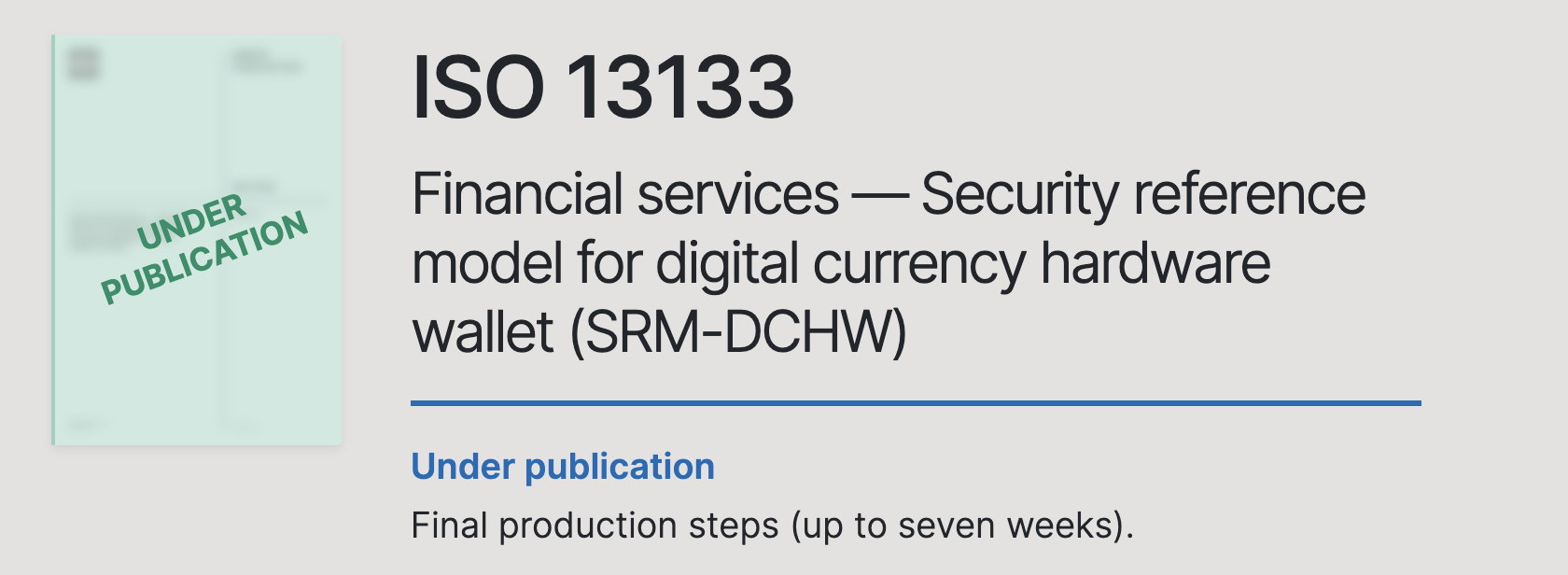
Currently nearing final publication is ISO 13133 (Financial services — Security reference model for digital currency hardware wallet). This international standard provides a formal framework specifically covering:
- Data Management & Access Controls: Security requirements governing communication across hardware modules.
- Execution Environment Security: Baseline rules for the software operating environment inside the wallet.
- Operational Life-Cycle Policies: Security controls during hardware manufacturing, firmware deployment, and servicing.
In addition to ISO 13133, broader chip-level benchmarks (such as Common Criteria EAL ratings and FIPS 140-3 certification for cryptographic modules) exist, but they are rarely enforced as mandatory prerequisites for selling self-custody hardware to the public.
Closing the Regulatory Void
Having an ISO standard under development is a welcome milestone, but a voluntary technical benchmark alone cannot fix an accountability deficit.
So long as hardware manufacturers operate in a voluntary compliance vacuum, the heavy financial burden of background software failures will continue to fall entirely on the end-user. If digital asset hardware is routinely marketed as the ultimate vault for personal wealth, shouldn't these devices be held to the same strict statutory liabilities and consumer protection laws as traditional financial safety products?
Until regulators mandate certified cryptographic build standards, compulsory third-party code audits, and strict disclosure duties, we must ask ourselves: Is it time for supervisory authorities to step in with harsher legal enforcement and binding regulatory requirements or will the industry continue to let baseline users pay the price for silent software mistakes?
Read the Coldcard Randomiser Flaw Triggers here.