Why Risk, Legal and Compliance Must Sit Closer to Marketing
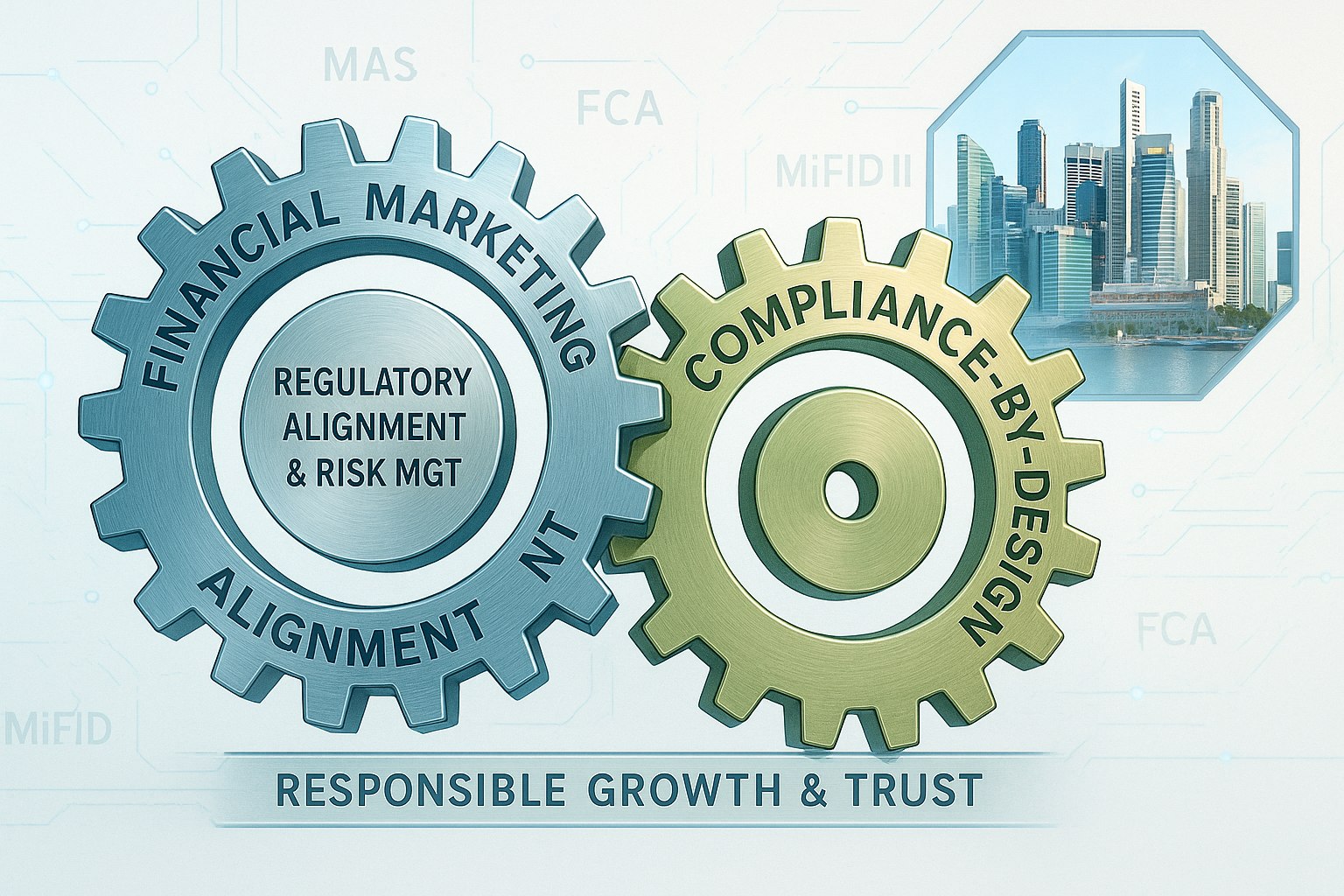
The Shift in Financial Marketing: Why Compliance-By-Design is the New Competitive Edge
In the highly regulated landscape of financial services, marketing is no longer solely a brand function; it is a conduct-risk function, a governance mechanism, and increasingly, a regulatory signal.
For decades, many firms operated under a fragmented model: marketing envisioned the campaign, public relations crafted the narrative, and Risk, Legal, and Compliance (RLC) teams served as the final checkpoint. Today, that siloed approach is not merely outdated—it is a distinct commercial liability.
With the proliferation of digital prospecting, cross-border promotions, and finfluencer partnerships, the demarcation between 'brand communication' and 'regulated solicitation' has fundamentally blurred.
The Cost of Operating in Silos
Professionals with a background in law and public policy are driving a completely different ball game within strategic marketing departments. Without their jurisprudential lens, firms risk severe statutory penalties. Depending on the jurisdiction, failing to adhere to regulatory advertising standards can result in crippling fines from bodies such as the Monetary Authority of Singapore (MAS), the UK’s Financial Conduct Authority (FCA), or under the EU’s MiFID II framework.
Equipping marketing teams with legal literacy—or integrating legally trained employees directly into these functions—radically reduces the manpower required for late-stage vetting and protects the firm's bottom line from avoidable jurisdictional breaches.
The MAS Imperative and Leadership Accountability
Regulators are actively patrolling the digital perimeter. MAS recently joined the Global Week of Action Against Unlawful Finfluencers, a coordinated, multi-jurisdictional initiative targeting non-compliant online content creators.
Furthermore, MAS’s Guidelines on Standards of Conduct for Digital Advertising Activities establish a definitive legal reality: Board and Senior Management bear ultimate, non-delegable accountability for ensuring digital advertising is conducted responsibly. This dictates that marketing strategy can no longer exist in a vacuum separated from governance and risk strategy.
The Vulnerability of Licence Applications
The necessity for an integrated RLC and marketing approach is magnified for firms currently applying for, or expanding, their financial licences. During these sensitive regulatory phases, marketing is an active reflection of a firm's internal control culture.
A premature product claim, an aggressive social media campaign, or an unlicensed recommendation can immediately trigger regulatory scrutiny regarding the firm's overall judgment and readiness. As MAS guidelines note, simply slapping a "this is not financial advice" disclaimer onto a post does absolutely nothing to absolve a firm or creator of legal liability.
Compliance-by-Design: The New Operating Model
The issue is not whether financial marketing should be creative, but whether that creativity operates within a robust control environment. This is where legally trained professionals transition from being final-stage blockers to upstream strategic partners.
They enable marketing teams to ask the critical questions during the ideation phase, rather than the approval phase:
- Is this content educational, or does it cross the threshold into financial advice or solicitation?
- Are we presenting a balanced view of both the risks and the rewards?
- Can this post stand entirely on its own, or does it rely on hidden caveats tucked away on a separate landing page?
- Are our affiliates and finfluencers contractually bound, properly briefed, and actively monitored?
While AI-enabled tools will undoubtedly streamline the drafting and preliminary review of marketing copy, AI cannot replace accountable human judgment. The paramount leadership question in regulated financial services is not, "Can AI check this copy?" but rather, "Do we have the right governance model surrounding the content our AI helps us create?"
The Governance Advantage
Financial marketing must be accurate, balanced, transparent, and strictly accountable. Governance, Risk, and Compliance (GRC) messaging cannot be treated as corporate window dressing; it must be underpinned by rigorous disclosure standards, surveillance mechanisms, and active training.
The most formidable marketing teams in the financial sector will not view regulation as a hurdle to be cleared at the eleventh hour. They will be the teams that weave legal literacy and regulatory judgement into their audience targeting, channel selection, and content creation from day one.
The leadership question is no longer: "Has compliance approved this post?"
The better question is: "Did Risk, Legal, Compliance, Marketing, and PR design this strategy together?"
Because in today's highly scrutinised environment, trust is not built by the messaging alone. It is built by the uncompromising governance behind the message.
Are your teams ready for this regulatory shift?
Read more on:
Guide on Responsible Financial Content Creation
Guidelines on Standards of Conduct for Digital Advertising Activities
MAS on Responsible Financial Content Creation on LinkedIn
This personal opinion piece by Shann Ng is exclusive to RegTech.com.
Answers drawn directly from this article.