Europe’s financial regulators have started treating the most powerful artificial intelligence models not just as a compliance question but as a potential source of systemic risk. The three European Supervisory Authorities, the EBA for banking, EIOPA for insurance and pensions and ESMA for markets, have called for tighter governance and more consistent supervision of the technology risks that frontier AI models pose to the financial sector, backing an earlier warning from the European Systemic Risk Board that those same models could become a source of systemic cyber risk.
Three Documents, One Regulatory Message
The timeline matters because the guidance arrived across three distinct waves over five weeks. On 25 June 2026, the European Systemic Risk Board (ESRB), the macroprudential body responsible for EU financial stability, adopted a formal warning (Warning ESRB/2026/3) classifying systemic cyber risks from frontier artificial intelligence models (FAIMs) as a macroprudential concern and publicly released it on 7 July. That same day, the three European Supervisory Authorities (EBA, EIOPA, and ESMA) issued a joint statement endorsing the warning. On 31 July, the ESAs went further, issuing practical supervisory expectations outlining the immediate governance and operational steps financial entities must take.
The ESRB pulled no punches in its risk rating. Having classified frontier AI cyber exposure as "elevated" in March 2026, the Board formally upgraded its assessment to "severe" by June. It defined frontier AI models in straightforward terms: advanced, general-purpose systems capable of materially altering offensive or defensive cyber operations, notably by discovering software vulnerabilities, weaponising exploits, and executing attacks within minutes rather than weeks. The regulatory takeaway is stark: the exact capabilities built to fortify network defences can just as readily arm threat actors.
Why Frontier AI Poses Systemic, Not Just Firm-Level, Risk
The macroprudential concern is not merely rogue conversational agents or localised algorithm errors. Rather, a small cluster of frontier artificial intelligence models (FAIMs) fundamentally alters the economics, velocity, and reach of offensive cyber operations across the entire financial ecosystem. European authorities highlight three primary systemic transmission channels:
Automated Exploit Generation at Scale: Frontier models compress vulnerability discovery and weaponisation timelines from weeks to minutes, rendering conventional, reactive patch-management assumptions obsolete.
Correlated Attacks on Shared Infrastructure: Offensive capabilities can be directed simultaneously against common core banking software, clearing systems, and critical cloud dependencies.
Exploitation of Single Points of Failure: By leveraging shared open-source components and concentrated ICT service layers, a coordinated strike can compromise multiple financial market infrastructures at once.
This transmission mechanism transforms isolated IT breaches into financial stability risks. If cyber-induced outages persist across multiple interconnected institutions or paralyse critical payment and settlement rails for several days, the fallout will spill beyond individual balance sheets into liquidity contagion across the real economy.
Beyond operational mechanics, the ESRB emphasises a critical structural vulnerability: the leading developers and infrastructure providers of frontier AI are concentrated almost entirely outside the European Union. In the eyes of European regulators, this concentration represents a critical third-party dependency and a geopolitical exposure under the Digital Operational Resilience Act (DORA), rather than a standard commercial procurement relationship.
No New Rulebook: A Sharper Reading of Existing Mandates
Crucially, this regulatory push does not establish a new statutory instrument. European authorities have made it clear that the current legislative architecture, principally the Digital Operational Resilience Act (DORA) and the EU AI Act, already offers a technology-neutral, robust foundation. The core directive is to integrate frontier AI risks directly into the compliance obligations institutions already hold, rather than treating them as an isolated, theoretical AI policy.
In practice, this expands the core DORA pillars to encompass frontier AI exposure across five operational vectors:
ICT Risk Management: Risk frameworks must explicitly account for the speed, scale, and asymmetry of AI-augmented cyber threats.
Resilience & Scenario Testing: Digital operational resilience testing, including Threat-Led Penetration Testing (TLPT) for significant entities, must advance to simulate automated, AI-accelerated multi-stage intrusions.
Incident Management & Continuity Planning: Response playbooks and business continuity arrangements must plan for simultaneous, correlated system disruptions rather than discrete, localised outages.
Deep Supply-Chain Oversight: Third-party risk management (TPRM) must reach past primary vendors to scrutinise broader software supply chains, including open-source libraries, developer APIs, and external security operations centres.
Lead Oversight Frameworks: Supervisory authorities have confirmed that, in their capacity as Lead Overseers for Critical ICT Third-Party Providers (CTPPs), AI-related systemic risk is being actively embedded into supervisory methodologies and prioritised in the 2027 oversight cycle.
A Different Reflex from Asia
The European move contrasts with how some Asian regulators have approached AI so far. As we reported, the Monetary Authority of Singapore kept agentic AI within proposed guidelines rather than binding rules, a lighter-touch, principles-first posture aimed at not smothering adoption. Hong Kong’s regulators have leaned into the upside too, with the HKMA backing wider use of AI by banks to fight financial crime. The EU is not banning anything either, but by routing frontier AI through DORA and a systemic-risk warning, it is signalling that resilience against these models is now a supervised expectation with a hard-law backbone, not guidance a firm can treat as optional.
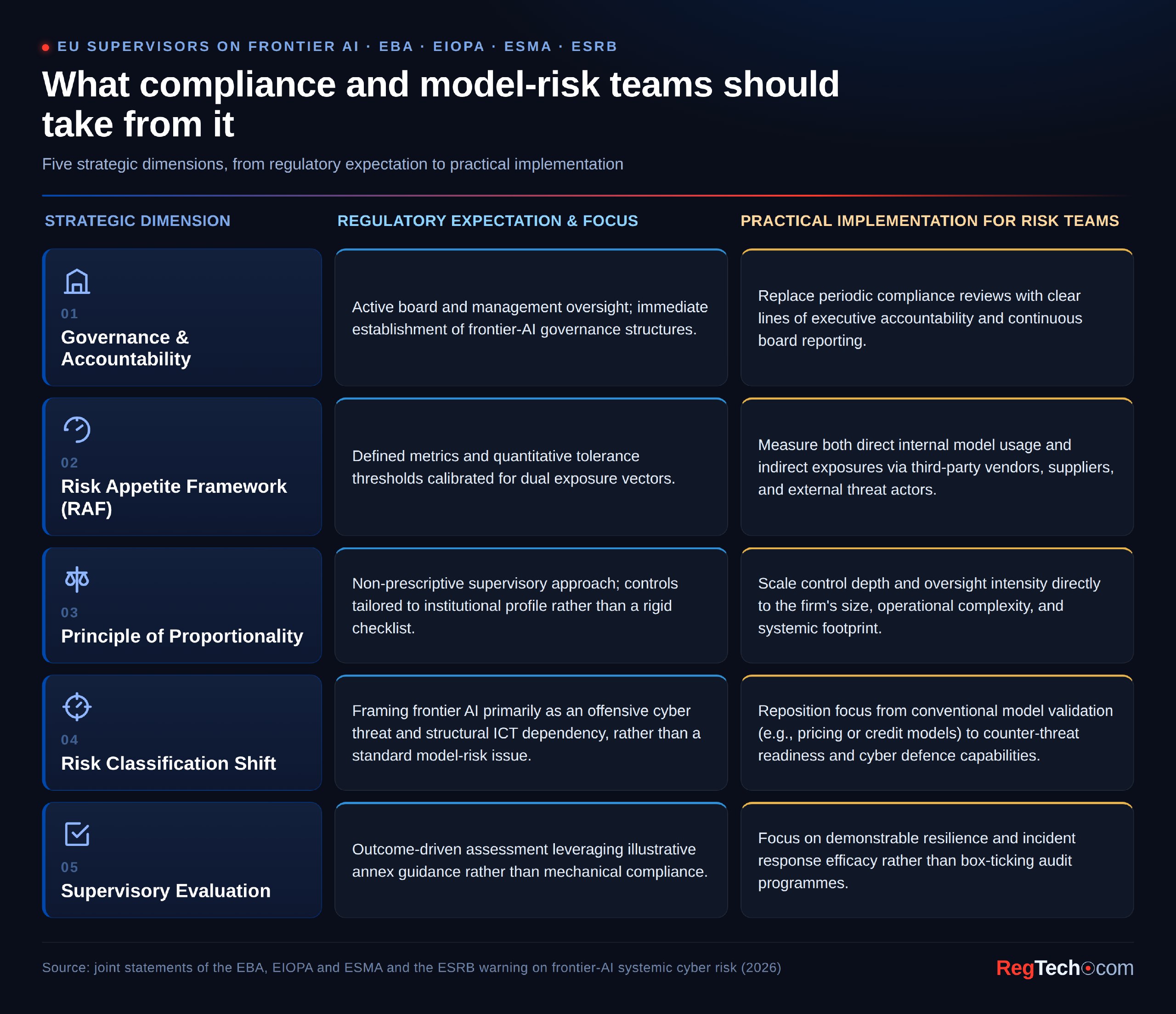
For compliance and model-risk teams, the message is to stop treating frontier AI as a future policy topic and start treating it as a live operational-resilience obligation. Regulators have said, in effect, that the technology is moving faster than the vulnerability cycle can absorb, and that firms should act early and proportionately rather than wait for a formal AI rulebook that, on this reading, is not needed to hold them to account.