The Hong Kong Monetary Authority (HKMA) has called on banks to embed artificial intelligence across their defences against money laundering and terrorist financing, moving the technology beyond trials and into the core of how suspicious activity is detected. The appeal came in a report circulated to all Authorised Institutions on 22 June 2026.
Supporting A.I. Adoption in Fighting Financial Crime, the paper carries a foreword by Raymond Chan, the HKMA’s Executive Director (Enforcement and AML). It forms part of the regulator’s Fintech 2030 vision and follows a September 2024 circular that asked banks with significant Hong Kong operations to assess the use of AI in monitoring suspicious activity and to submit implementation plans.
Why the HKMA sees a turning point
The report ties the case for change to the speed of digitalisation. It notes that Faster Payment System transactions have climbed by 229 per cent over four years and registrations by 106 per cent, while remote account opening reached 74 per cent of all accounts opened in the fourth quarter of 2025. At the same time, the HKMA warns that AI driven scams and synthetic identities are making criminal activity harder to spot, leaving static, rule based controls under growing strain.
Mr Chan writes that “standing still in the face of such rapid change is not an option” and stresses that innovation must be matched by accountability. Where AI shapes risk assessments or decisions, he says, responsibility stays with senior management and boards, adding that “technology does not replace governance”. Banks, the report argues, must be able to explain how their models work, how outcomes are validated, and how risks such as bias, drift and over reliance are managed.
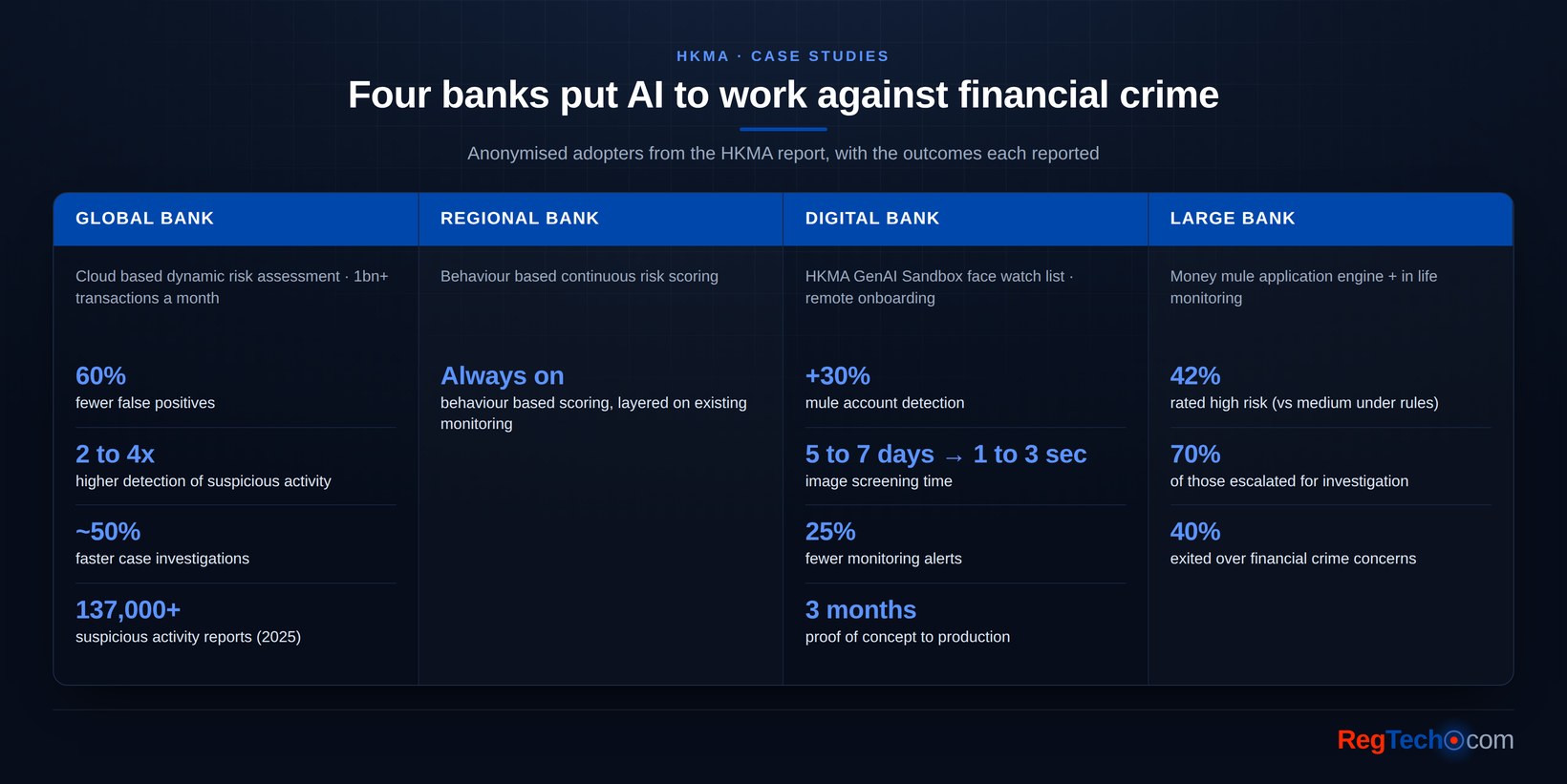
Case studies from four banks
The report anonymises four adopters of different sizes and sets their approaches and reported results side by side. The comparison below captures each bank’s headline outcomes at a glance.
What supervisors expect over the next two years
The HKMA frames the coming 24 months around four priorities:
- delivering measurable effectiveness rather than experimental activity;
- embedding cross-line governance and clear accountability;
- shifting from rule based monitoring to intelligence led risk management;
- and deepening collaboration across the sector, including through public private partnerships.
It observes that while more than half of institutions report deploying AI within risk functions, fewer than one third operate fully integrated model governance across their lines of defence.
To close that gap, boards and senior management are expected to place financial crime expertise directly within frontline business units, form cross-line committees to oversee AI models, treat accountability for AI performance as a responsibility shared across the business, set board-approved risk appetites, and monitor models in real time for drift, bias and explainability. Accountability for meeting anti-money laundering obligations, the report is clear, rests with financial institutions and their control functions, not with the tools they use.
The regulator also points to what comes next. A second industry workshop, focused on agentic AI, was scheduled at the Hong Kong University of Science and Technology on 23 June 2026, and the report identifies supervised, human-led use of such systems as a future focus of its programme. Banks with significant Hong Kong operations have already lodged implementation plans, which the HKMA expects to keep under review, with progress reported when called for.