What Is RegTech? A Practical Guide for Financial Institutions
Ask ten compliance officers what RegTech means, and you will hear ten different answers. One will describe an onboarding tool. Another will point to a transaction monitoring engine. A third will talk about regulatory reporting. Each of them is right, which is exactly why the term needs a clearer explanation.
At its simplest, RegTech (regulatory technology) means using technology to help regulated firms meet their obligations more reliably, more efficiently and with better evidence that they have done so. It is less a product category than a way of running compliance.
How regulators define it
The Monetary Authority of Singapore (MAS) offers one of the cleanest definitions on its RegTech page:
“RegTech is the use of technology to enhance risk management and regulatory compliance in financial institutions.”
Monetary Authority of Singapore
The UK Financial Conduct Authority (FCA) was among the first regulators to promote the term. It began exploring RegTech in 2015 and, in a July 2016 feedback statement, described it as a subset of FinTech focused on technologies that may deliver regulatory requirements “more efficiently and effectively than existing capabilities.” In 2020, the Financial Stability Board (FSB) took a deliberately broad view in a report to the G20, covering any application of FinTech to the regulatory, compliance and reporting requirements of regulated institutions.
The wording differs, but the thread is consistent. RegTech sits with the regulated firm. It concerns how a bank, insurer, payments company or digital asset business carries out its own compliance work.
RegTech is not SupTech
The distinction matters. The Financial Stability Institute of the Bank for International Settlements defines supervisory technology, or SupTech, as “the use of innovative technology by supervisory agencies to support supervision.” One belongs to the regulated firm. The other belongs to the regulator.
The two are increasingly linked. As supervisors become more data-driven, the quality, structure and timeliness of what firms submit carries more weight. A firm with fragmented reporting data will find that weakness exposed sooner rather than later.
Where it is used today
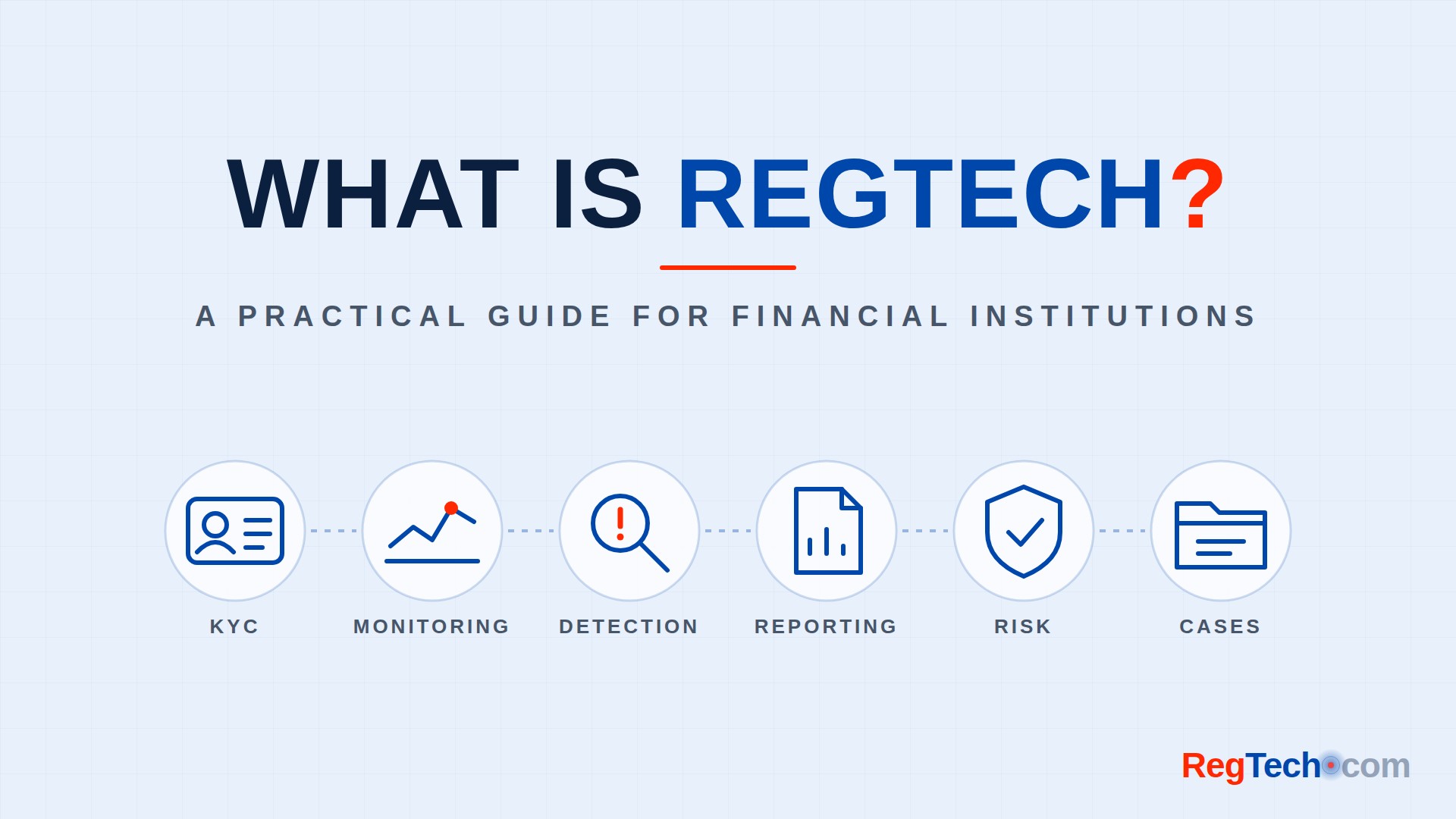
MAS groups RegTech applications into six areas. In practical terms:
- Know Your Customer and ongoing due diligence: digitising onboarding and periodic reviews to catch financial crime risk earlier.
- Transaction monitoring: applying rules, artificial intelligence and machine learning to surface unusual payments.
- Suspicious activity detection: assembling the information investigators need and supporting the filing of suspicious transaction reports.
- Regulatory reporting: automating submissions to cut data errors.
- Risk management: spotting, assessing and reducing compliance and regulatory risk.
- Case management: keeping a digital, auditable trail of every action taken.
Other authorities draw a similar map. The FSB found that regulated institutions mainly use RegTech for fraud detection, reporting, risk management and AML/CFT, with growing activity in KYC and identity verification. The European Banking Authority’s 2021 analysis examined five segments: AML/CFT, fraud prevention, prudential reporting, ICT security and creditworthiness assessment. The Financial Action Task Force’s 2021 report on new technologies found that 52 percent of respondents saw RegTech as the AML/CFT area where most of the benefits of new technologies could be realised.
The Strategic Imperative
The FSB traced the growth of RegTech to the heavier regulatory requirements introduced after the 2008 financial crisis. That pressure has not eased. Instant payments, digital assets, and organised fraud networks now move faster than manual review can keep up.
Regulators have actively encouraged adoption. In 2021, MAS introduced a RegTech grant scheme for Singapore-based financial institutions, with funding capped at S$75,000 for pilot projects and S$300,000 for production-level projects. Its FinTech Regulatory Sandbox lets firms test new products and services within defined boundaries. In Hong Kong, the HKMA published a two-year RegTech roadmap in 2020 with 16 recommendations, including a RegTech Adoption Index and a Global RegTech Challenge.
Technology does not replace judgement
None of this makes compliance automatic. The FSB cautioned that tools built on historic data can draw the wrong conclusions about the future, and that RegTech and SupTech tools may lack transparency. The EBA listed risks ranging from concentration and business continuity to ICT security, internal governance and consumer protection.
A model that cannot be explained to a supervisor is not a control. It is a liability. Firms that succeed with RegTech start with the obligation, not the tool: what must be done, what evidence proves it was done, and who is accountable when it fails. Only then does the technology question begin.
That accountability cannot be handed to a vendor or an algorithm. Boards and senior management remain answerable for outcomes, which is why compliance must be designed into the business from the outset, a point I have made before about why risk, legal, and compliance must sit closer to marketing.
The bottom line
RegTech is compliance carried out with better instruments. Used well, it gives firms faster detection, cleaner data and a defensible record of what they did and why. Used carelessly, it simply automates blind spots. The difference lies not in the software but in the governance around it.
Answers drawn directly from this article.